When AI Tools Each Carry Their Own Brand Assumptions the Voice Fractures
Without shared brand context, AI tools drift into their own voice interpretations across your stack.

To spot when AI output drifts off-brand, check it against clear rules for tone, messaging, and visual identity, with evidence for each check. When tools each supply their own brand assumptions, voice fracture is an architectural problem. A shared, machine-readable brand context gives generation and review the same standard across tools, while better prompts alone keep that standard in one tool.
Why each AI tool defaults to its own idea of "good" content
A generic image model given the request “a confident professional in a modern office,” produces the statistical average, a stock-style result available to any other brand. The request describes a subject and setting, but it does not define a particular visual identity. The model fills that gap from its training data. Its answer may satisfy the request without expressing anything distinctive about the business commissioning it. A suitable image is not necessarily a branded image.
The same mechanism applies to writing tools. Each arrives with implicit assumptions about what good content sounds like, including how confident language should read and what professional language should exclude. Those assumptions reflect the aggregate of the model’s training data, leaving a particular brand’s voice, values, or visual language unspecified. Without access to those decisions, the tool substitutes its own defaults for the missing context.
A polished result can be competent on its own terms while using the wrong register, sentence construction, or imagery for the brand. The problem is not that the tools are bad. It is that each has a different substitute for the identity it cannot see. Evaluating only whether an asset looks or reads well therefore leaves the central question unanswered, which is whether it belongs to this brand.
How fragmentation compounds once agents operate across a stack
A content agent that cannot see analytics, an SEO agent that does not know brand voice, and a publishing agent with no strategic context can each make reasonable decisions. Their decisions need not agree. Each works from a partial view of what the business needs, so success within one task can pull against the direction established elsewhere. Adding autonomy to this arrangement amplifies fragmentation.
This fragmentation produces a collection of “mini voices. Each may be internally coherent, with its own interpretation of tone, emphasis, and presentation, while the combined output points in different directions. This is more difficult to recognize than random noise because individual assets can look finished and deliberate. A marketing director reviewing a single channel may find little wrong with it. The fracture becomes visible across channels, where separate versions of the brand accumulate.
Agent coordination adds another source of divergence. Each agent may have its own role, tools, memory, and partial view, while what gets shared and how the next agent interprets an output remain design decisions. Those decisions do not disappear when teams leave them unmade. Memory also limits continuity, since most foundation AI image generators do not retain or enforce brand context across generations by default. Without additional tooling, each generation effectively restarts from zero, making a previous on-brand result a poor basis for expecting the next one.
What this costs when it reaches buyers and clients
People on a buying committee often judge a vendor on their own across different touchpoints. Consistency helps them reach a common understanding of the business, while fragmented messages make internal consensus harder to achieve. What appears as channel variability in a CRM can look like an extended sales cycle from the buyer’s side. The commercial cost lies in that gap. Individual interactions may be persuasive without helping the committee agree on what the vendor represents.
The sequence of brand and agent deployment changes the outcome. Companies that make their brand consistent before they deploy agents give those interactions a shared identity to build on. Companies that deploy agents first, without that foundation, create a more diffuse and less recognizable impression. More output gives buyers more encounters with different interpretations of the same business, turning a production problem into a revenue and relationship problem.
For agencies, that divergence also reaches client review. A finished asset can look good in an informal check yet fail an audit against the client’s voice, messaging, or visual rules. Polish is not proof of compliance. When the work is individually credible but collectively inconsistent, compliance depends on the relationship among assets, where failures may escape a review of individual pieces.
Why better prompts don't fix a structural problem
More detailed prompts are the instinctive response because they can improve an individual result. Including voice rules and visual guidance gives a tool information it previously lacked. That improvement is real but local. Prompt-based context exists for one session, is not inherently shared across tools, and must be reconstructed by hand for the next request. Treating that reconstruction as the operating model turns an architectural gap into a recurring instructional task.
Even a perfect prompt in one tool does not establish a relationship with another tool’s output. The second tool still uses the context it gets and its own defaults to fill the gaps. Across a team, people have to keep separate instructions in line with each other across tools and creative work. Careful prompting can achieve consistency within one tool, managed by one person, at low volume. That is a narrower achievement than maintaining one voice across a diverse production stack.
Reviewing prompts alone also gives an incomplete account of agent work. Trace2Flow research studied 20 participants who reviewed AI agent executions and found that validation worked mainly when they could cross-check evidence from more than one source. Its editable, graph-based representations of completed workflows improved understanding and error detection over prompt-only review by making execution visible across steps. The study concerns agent review. Its relevance is the limit it exposes in treating the initiating instruction as sufficient evidence of what happened.
The stronger the dependency on repeated prompting, the more consistency depends on each person reconstructing the same decisions correctly. A good instruction can guide an execution without governing the wider system. That distinction is the hinge of the problem.
What a shared brand context layer actually is and how it works technically
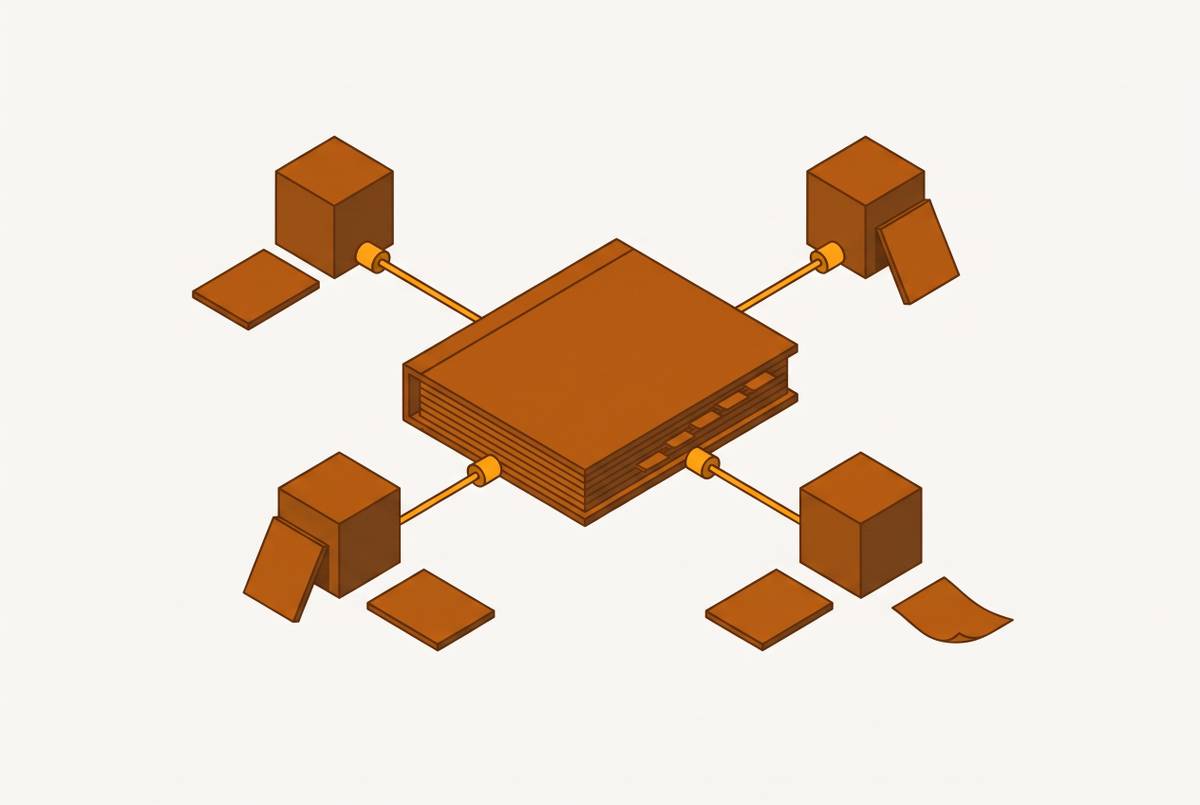
A shared brand context layer encodes brand identity once in a machine-readable format and makes it available to connected agents and tools from a single source. A static PDF updated annually and checked through manual QA serves a different purpose from a JSON/API format with versioning and validation endpoints. The latter can participate in the workflow itself.
Anthropic introduced Model Context Protocol, or MCP, in November 2024 as an open standard for connecting AI tools to external context. For brand workflows, it allows writing assistants, image generators, and code agents to pull guidelines, palette, typography, and voice rules into generation without copy-paste. MCP servers provide direct access to that context, while webhooks push updates when the brand evolves and validation endpoints check compliance. The brand becomes an input to the system. It no longer depends entirely on someone remembering to attach the right document.
The July 28, 2026 revision to MCP made the protocol stateless at the protocol layer. Protocol metadata, including version, client information, and capabilities, travels with every call. Application state is a separate concern. Servers can manage it through explicit server-minted handles passed as tool arguments, so brand infrastructure needs to plan for context access on every request.
Stripe, Linear, Sentry, and Vercel were among early adopters that shipped MCP servers in 2025, providing direct, structured product connections for AI assistants without a crawl. These examples establish the connection pattern. Claude, ChatGPT, Claude Code, Cursor, Codex, and other MCP-compatible agents can connect through MCP, while teams integrating context into their own products can use a REST API. Both paths draw from the shared source.
What the shared context layer must contain to hold voice consistent
A shared source is useful only if it contains the decisions agents need to make. A mission statement alone cannot define how a campaign image should look or how an email should sound. Visual DNA has a machine-readable palette, logo files as vector assets, specifications for typography, and rules for imagery. Without those details, image-generating agents can still fill in their own ideas of how the brand should look.
Voice requires an equally concrete description. Tone, register, sentence construction, and what the brand never says do more to set one brand’s identity apart from another than a broad request to sound professional. Messaging rules spell out what the brand should say in that voice. Together, these criteria allow a change in register or prohibited wording to be identified as drift by assessing it against an explicit rule.
The layer also needs to translate core context into task-specific briefs. A campaign image brief is not an email brief, and putting the entire brand kit into every prompt does not make that distinction. Each task needs the relevant subset of logo, type, color, imagery, and voice guidance. The core remains shared while the brief is scoped. This preserves a common identity without treating every generation task as if it required the same inputs.
Versioning keeps those decisions in step as the brand changes. Every connected agent needs to work from the new version automatically, because context that becomes outdated without propagating is another silo. Measurement, diagnostics, and playbooks can be shared, while each brand retains its own voice layer. The discovery layer travels across the portfolio, but the voice layer does not.
How brand-aware agent workflows detect off-brand output through review
Shared context at generation is necessary, but it does not prove that the finished work follows it. To spot drift, review the work against the same context, with evidence for each check before the work is published. Otherwise, a generation pipeline can produce work that is internally coherent but off-brand, and a reviewer can approve it using a different set of assumptions. At high creative volumes, that gap can compound silently.
Brand-aware workflows make review an agent task in its own right. One agent generates the work, a second checks alignment with voice and messaging, and a third verifies compliance with claims or legal requirements. The separation gives each review a defined purpose. It does not remove the need for evidence, since another agent’s approval is not by itself proof that a rule was followed. Human review also needs more than an unaided impression of the finished asset.
The warning signs are specific departures from the shared standard, including the wrong tone or register, sentence construction that conflicts with voice rules, prohibited language, and imagery based on generic assumptions that conflicts with the brand’s visual DNA. Review should connect each finding to the relevant criterion. A structured audit can show why an asset is off-brand, while a general pass or fail leaves the basis of judgment unclear.
Cross-checking evidence across the completed workflow extends the same architectural principle to the output end. Consistency is therefore not entrusted to a persuasive prompt or a polished result. It is built into the relationship between the governing rules, the generated work, and the evidence used to approve it.