Shared Brand Context Is Not a Prompt It Is a Persistent Reference Agents Sync to Before They Write
A versioned brand reference keeps agents on-brand and exposes drift.
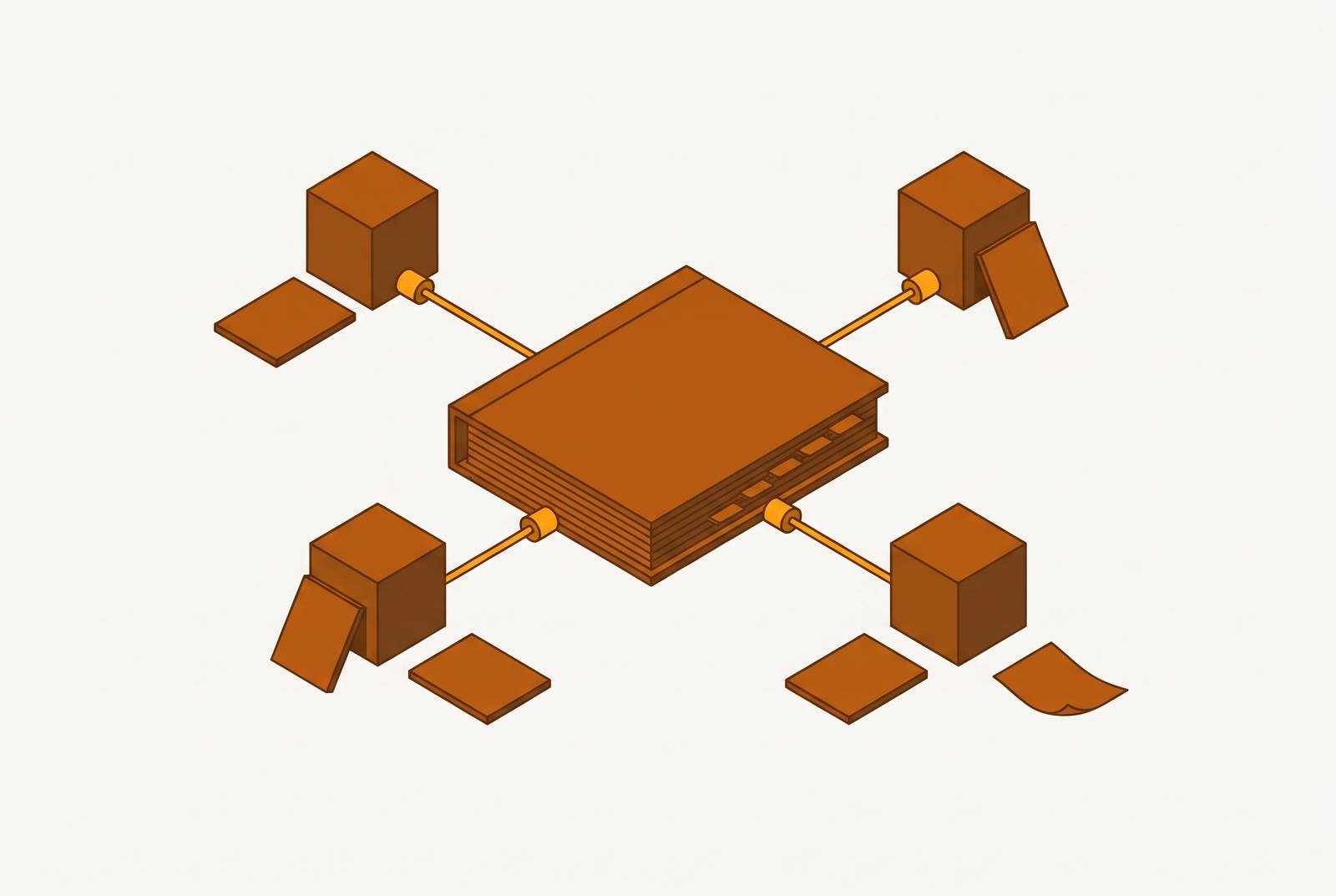
To detect when AI output drifts off-brand, check it against clear voice, visual, and task-specific rules, with evidence for each check. Preventing that drift requires a persistent, versioned brand reference that agents sync to before they write. Shared brand context is not a prompt delivered once, but a governed source used both to guide production and to review the result.
Why brand context in a prompt is not the same as brand context in a system
A prompt belongs to a session, while a persistent reference exists independently of it. Brand guidance pasted into a conversation can inform that conversation, but it does not become shared infrastructure. Once work spans multiple agents or sessions, the guidance must reach independently deployed services that may share no infrastructure. A carefully written prompt cannot, by itself, make that happen.
Anthropic’s Model Context Protocol announcement identifies the underlying constraint as models’ isolation from data behind information silos and legacy systems. Brand data presents the same problem. An agent that creates copy, images, or campaign structure makes choices about the brand whether it has guidance from an authoritative source or not. Without a persistent reference, each session must reconstruct those decisions from whatever context is available. A versioned, queryable source gives every agent a reference it can read before it starts work.
How prompt-based brand guidance breaks as agent volume grows
Prompt-based guidance asks models to infer operational rules from prose. A guideline such as “our tone is warm and direct” leaves considerable room for interpretation. Two agents need not interpret it alike. As more sessions and channels enter the workflow, those independent readings introduce tone inconsistency and hallucination risk. Every new session repeats the act of interpreting the original instruction.
In an agentic marketing workflow, that repetition can occur across research, drafting, review, and optimization. Without a shared reference, each step can reinterpret the brand. Review then has no fixed set of rules for correcting a draft. Optimization may introduce another reading of what the brand should sound like, so a chain intended to refine work can compound differences instead. Increasing output volume exposes this weakness.
The agency version adds the risk of cross-client contamination. A font, color, or voice rule can enter the wrong client’s work when context depends on human memory or copied text. Better prompting alone cannot govern those boundaries. Nor does a pasted instruction provide version history, an audit trail, or a mechanism for distributing an update to every agent in use.
What a persistent brand reference actually looks like in practice
A persistent brand reference is structured data with explicit field values, version history, and a stable address. Agents can query it before beginning a task. Instead of leaving “warm and direct” inside a prose guideline, the reference represents tone through explicit fields and values. Formality, personality, and constraints have their own fields rather than remaining implied by the surrounding text. Those separate fields make the rule clear both when agents generate work and when they review it.
The same structure extends beyond verbal identity. Visual identity becomes declarations about logo, color, type, and imagery that can travel with an agent request. Governance connects each field to its source and version. Together, these layers describe not only what the brand requires, but where the requirement came from and whether it has changed. An update therefore belongs to the reference rather than to an unknown number of copied instructions.
The practical artifact can be a structured Markdown, YAML, or JSON file, or a queryable endpoint containing brand strategy, voice, and visual rules. The format alone is not the solution. Saving a prose document as a different file type still leaves agents to work out its rules from the text. Traditional guidelines are still useful, but the reference that machines read needs a clearly defined schema. Its purpose is to turn brand decisions into accessible parameters.
Why MCP is the right delivery layer for brand context
The Model Context Protocol, or MCP, supplies a standard connection between the reference and compatible agents. Anthropic’s specification describes developers exposing data through MCP servers and AI applications connecting as MCP clients. This replaces fragmented, one-off integrations with a shared protocol, so each tool need not receive its own custom connection to the same underlying brand rules.
MCP exposes three primitives, which are tools, resources, and prompts. Brand rules can be a readable resource, brief-generation logic can be a callable tool, and task-specific workflow templates can be prompts. The presence of prompts does not contradict the persistent-reference model. Here, a prompt organizes work around a shared source rather than acting as the only place the brand guidance exists.
OpenAI adopted MCP across products including the ChatGPT desktop app and later added support to ChatGPT apps. That adoption allows the same brand server to serve compatible agents across vendors without a separate integration for each one. The reference need not depend exclusively on MCP, however. A REST API can expose the same governed context to other workflows and products. MCP is the delivery layer, while the authority of the brand rules belongs to the underlying reference.
Versioning brand context the way code is versioned, and why it changes what agents receive
A stable address solves access, but not change. Without versioning, a persistent reference remains a static document that agents can find. Brands evolve through voice refreshes, new logo lockups, and revised color palettes. In a prompt-based system, each change requires locating and replacing old guidance wherever it was copied. There is no guarantee that every copy will be found.
A versioned reference makes the update once at the source. Every agent that queries it before its next task receives the new version without a person revising that agent’s prompt. Reading at the start of a project is not equivalent to syncing before each task, because the reference may change between them. Version history also records the source, date, and replaced guidance, allowing a regression to be diagnosed and reversed.
That history has a legal role as well. The June 2026 New York synthetic performer disclosure law placed a conspicuous-disclosure duty, triggered only by actual knowledge, on those who produce or create advertisements containing AI-generated synthetic performers, including advertisers and their agencies. It expressly excluded media publishers and platforms that merely disseminate them. In that setting, the brand governance record can also serve as a compliance record.
How to detect when AI output drifts off-brand through briefs, checks, and review
Off-brand signals are departures from the applicable voice parameters, logo lockup, type rules, color constraints, or imagery guidance. Detection starts with those named criteria, which give more to go on than a feeling that an output is wrong. The criteria must also fit the task. A campaign image and an email draw from the same brand identity, but they do not need an undifferentiated copy of every rule. A task-specific brief selects the relevant requirements before production begins.
That brief is the operative artifact for the agent. It translates the persistent reference into the voice and visual parameters governing the particular piece of work. After generation, the same reference supports a field-by-field audit with evidence for each check. Tone and voice can then be checked across outputs using the same criteria, without each review having to work out the rules anew.
The review loop connects each output back to its instructions. A prompt can tell an agent what the brand is at the beginning of a session, but it does not itself verify the finished work before release. A departure becomes a specific discrepancy to examine rather than an argument about remembered brand intent.
Superside’s Brand Brain illustrates the use of accumulated brand context in creative work. Its AI context engine captures client guidelines, tone, audience personas, previous assets, feedback, and creative decisions to support briefing, generation, and later projects. Superside used it to help D2L Brightspace produce a large volume of on-brand ad variations with significantly less design time.
The architectural objection: embedded context per agent versus a shared brand store
Embedded context puts the rules an agent needs inside its message payload, so it can use them without querying a shared store. A coordinator chooses which part of the context each task needs. Agents can then remain stateless, independently deployable, and limited to the context required for their work.
Embedded payloads provide resilience by allowing agents to keep working if the brand server is unavailable or compromised, and each can be tested and deployed on its own. Payload size can be managed through summarization that bounds context to the most recent and relevant brand parameters. A shared-reference design must allow for these needs, since the same way of delivering context will not suit every system.
Local copies diverge when the brand changes unless a governed source supplies their contents before embedding. The shared store and the payload therefore solve different problems. A coordinator can draw current, task-scoped context from the versioned reference and deliver it inside the message an agent receives. Both patterns are present in 2026 production systems, and the strongest architecture combines governed content with the delivery model the workflow requires.
What it takes to make a brand agent-ready, and where to start
Making a brand agent-ready begins with a governance decision. Brand context must be treated as infrastructure with version control, source attribution, and reliable propagation. The practical work begins with an audit of where that context lives. A PDF, a Notion document, and the knowledge of long-serving employees may describe the brand well, but they do not together constitute a machine-accessible, versioned reference.
The minimum viable reference needs structured verbal identity, structured visual identity, and a mechanism for versioning and propagating changes. Tone, voice, and constraints become field-level values, while logo, colors, type, and imagery become explicit parameters. An agent working for one client must not draw rules, assets, or voice from another. Shared infrastructure is useful only if it preserves that separation.
This changes the role of human marketers. Maintaining the schema, resolving its rules, and keeping its contents current become strategic responsibilities because agents depend on that reference to generate and assess work. Prompts still define assignments, and embedded payloads can still deliver context.
Sources
- Always-OnAgents:A Survey of Persistent Memory, State, and Governance in LLMAgents
- Create brand context for AI agents using your brand website or SitecoreAI site
- Context Engineering: From Prompts to Corporate Multi-Agent Architecture
- The New MCP Roadmap
- Infrastructure for the Agentic Web: Gap Analysis and Architecture from the Agentverse Platform