Versioning Brand Voice Like a Codebase
Treat brand voice as versioned code to prevent AI drift across teams.

A support team's AI assistant answers a billing question in the calm, precise register legal approved. A marketing assistant, two departments over, answers a nearly identical question in the loose, cheerful tone built for social captions. Nobody changed a policy. Nobody edited a style guide. The brand still sounds like two different companies by lunchtime, and the reason splits into two distinct mechanisms that a standard style guide was never built to catch.
The first is team-induced drift. Someone on staff writes their own version of the brand prompt because the approved one felt clunky, or because they didn't know an approved one existed. The guidelines sit untouched in a shared drive while the actual instructions driving the output quietly diverge from them underneath. The second is harder to see and harder to blame on anyone: model-update-induced drift. The AI vendor behind the tool pushes an update, and the same prompt that worked last month gets interpreted differently this month. No one edited anything. No log entry marks the change. The instructions are static; the output isn't.
Neither failure appears in a style-guide audit, because the document itself still reads fine. The breach is invisible until the content has already shipped. That blind spot gets more dangerous as the content stack grows: a mid-size company today runs AI across marketing, support, product, and internal communications, often through a different platform for each. A tone setting adjusted inside one of those tools is a local preference, not a company-wide rule. For an agency managing several clients at once, a single ungoverned prompt can quietly spread the same drift across dozens of pieces of content before anyone notices the pattern.
The style guide as a document is the wrong unit of truth
The PDF style guide fails for a simple structural reason: AI agents can't read it, can't enforce it, and can't compare one version of it against another. Humans struggle with the same task once volume climbs, since no reviewer can manually check tone, vocabulary, and claims across hundreds of AI-generated pieces a week.
The system prompt is the layer deciding whether an output matches the brand, and at most companies that prompt lives as a string buried in a codebase. Marketing can't read it. Compliance can't review it. Nobody outside engineering can change it. The group with the deepest knowledge of what the brand should sound like has no access to the mechanism that produces it.
Voice rules also need to live at different levels of the stack, and a single flat document can't represent that. Safety constraints belong in the system or policy layer. Tone traits and the do's and don'ts of brand language belong in the product instructions. Escalation style, the shift in register when something goes wrong, belongs in templates built for that moment. A PDF flattens all three into one block of prose that nothing downstream can query, leaving every rule to compete for the same paragraph regardless of where it's actually needed. What should replace the PDF is a structured set of rules an agent can retrieve and a machine can check: defined tone ranges, required and banned terms, rules about what claims need support, and limits on which sources can be cited. Without that structure, every agent is left to interpret the brand on its own, and what looks like one voice becomes a collection of private, slightly different copies of it.
Versioning brand voice in practice
Versioning brand voice means treating it the way engineers treat a codebase: as a structured artifact that can be compared across versions, rolled back when something breaks, and reviewed before a change goes live, rather than edited in place with no record of what changed or why.
The base artifact is something like a voice-spec.md file, a structured document that translates the style guide into rules a machine can actually use. It defines tone ranges for different scenarios, preferred sentence structure, vocabulary that's encouraged or banned outright, and a set of canonical examples showing what "sounds like us" and what doesn't.
A commit, in this model, is a deliberate and approved change to that spec: a new term added to the banned list, a tone range adjusted for a new channel, a claim rule made stricter, each one carrying a stated reason. A diff compares the current version against the one before it, showing what changed, who changed it, and when, the same visibility an engineer gets from reviewing a pull request. A rollback is the ability to revert to the last version that worked if a model update or a bad prompt edit starts producing output that no longer sounds right, instead of manually patching content after it's already published.
Versioning this way also builds the audit trail that compliance and legal teams need: every change logged, every published piece traceable back to the exact version of the spec that governed it at the time. If nobody is checking whether the voice in production still matches the spec, that record-keeping doesn't prevent drift from reaching readers. That's the role of voice QA, measuring consistency the way a product team measures performance. Voice drifts regardless of how carefully the spec is written, unless someone is watching for it.
The three layers where voice rules need to live for versioning to hold
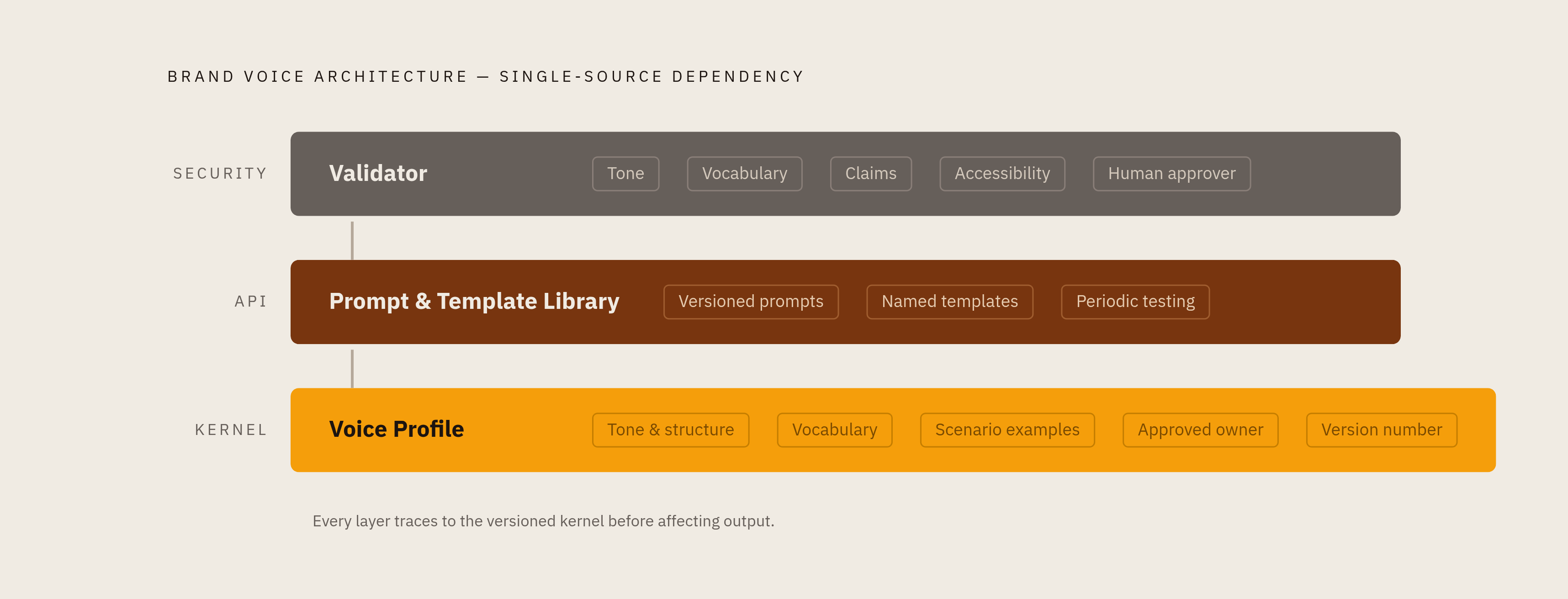
Versioning only works if the voice spec is the one authoritative source that every other layer of the stack pulls from, instead of each layer keeping its own local copy that quietly falls out of sync.
The first layer is the voice profile itself: the structured document encoding tone, sentence structure, vocabulary, and scenario-specific examples. Every agent should query this layer before it generates anything. It should exist as a JSON or markdown file, readable by a person and usable by a machine at the same time, with any change to it requiring an approved owner and a new version number before it can affect downstream output.
The second layer is the prompt and template library. Prompts need to be treated as infrastructure, not personal notes a team member keeps in a text file. That means they're versioned, named, and built from the central voice profile rather than rewritten from scratch by whoever happens to be using the tool that day. Templates built on top of that library enforce required intros, calls to action, and structural patterns, and they get tested periodically to confirm they still match the current version of the voice spec.
The third layer is the validator: a check that runs on tone, vocabulary, claims, and accessibility before anything publishes. Content that fails routes to a human approver instead of shipping automatically, and every pass or failure feeds a brand-quality scorecard. Just as important as the pass or fail result is what gets logged alongside it, every diff, every owner, every stated rationale, tagged with trace IDs and kept under a retention policy so the record holds up under audit.
Thought of as a system, the voice spec functions as the kernel, the prompt library as the API built on top of it, the validator as the security layer checking what tries to pass through, and the scorecard as the telemetry reporting back on how the whole thing is performing. Every asset the brand produces should trace back to one specific version of that kernel.
MCP as the mechanism that makes a versioned voice spec a retrievable, live signal for every agent
A versioned voice spec sitting in a repository doesn't do anything by itself. It has to be retrievable by the agents actually generating content, or it's no more useful than the PDF it replaced. A standard protocol for connecting AI agents to external tools and data makes the spec a live signal.
MCP lets an agent query the current version of the voice spec at the moment it's about to generate something, rather than depending on whatever was pasted into its prompt when someone first set it up months earlier. In practice, that means an agent can pull the live voice profile, check an approved library of sources, and reference past on-brand examples by name before writing a single word, grounding its output in the brand's current, specific state instead of whatever generic patterns it picked up in training.
When the voice spec changes, maybe a term gets added to the banned list, or a tone range gets adjusted for a new channel, every agent connected through MCP inherits that update automatically. Nobody has to go back and re-prompt every tool across every team.
Rainbrand's Brand Skill is one working example of this idea in practice: a versioned, retrievable representation of a brand's aesthetics, voice, references, and assets, built so that any connected agent or product can pull from the same canonical context through the API or through MCP. Whichever path an agent uses to reach it, the result is the same: the version of the voice spec running in production is always known, and it's always the current one.
What counts as a "commit" to brand voice
Versioning only prevents drift if a team agrees, ahead of time, on what counts as a commit and what signals mean a version already in production has quietly fallen out of line with the spec.
Certain changes should always trigger a new version. Adding a term to the banned or required vocabulary list is one. Adjusting a tone range for a new channel, a new audience, or a new type of content is another. Tightening a claim rule, say, requiring a citation or a human sign-off before a certain kind of statement can be published, is a third. A new canonical example replacing an old "sounds like us" or "not us" sample belongs on the list as well. The one that catches most teams off guard is the fifth: a provider-side model update that changes the output of an unchanged prompt counts as a version event too, even though nobody touched the spec itself. The fix is to update the spec so the output gets re-anchored to what the brand actually intends.
Detecting drift between versions depends on a handful of signals from the telemetry layer. A rising exception rate, more outputs failing the validator's tone or vocabulary checks than the previous version's baseline, is the clearest sign something has shifted. A rising rework rate, editors sending more content back for revision than usual, often means the prompt library has started to drift from the spec it's supposed to be drawing from. The validator catching banned terms or disallowed claim patterns that hadn't shown up in recent production runs is another concrete flag. And tone mismatches by content type matter too: if the spec defines a calm, conservative register for high-stakes content and an agent answers a billing dispute with the same cheerful certainty it uses for a product announcement, that's a drift event the system should catch, not something a reader should have to notice first.
Every commit needs a record behind it to hold together. Every commit needs a rationale, an owner, and a timestamp attached, not only to satisfy a compliance checklist, but because a rollback has nothing to revert to if there's no record of what the last good version actually was. For agencies or any company managing more than one brand, the same discipline applies separately to each one: a change approved for one client's voice spec should never bleed into another's, which makes version isolation just as important as version control itself.
Structured versioning as the only durable defense against both sources of drift
Ad-hoc prompting and tone settings adjusted inside one tool at a time share the same structural flaw: there's no canonical state to measure against, so there's nothing concrete to detect, nothing to roll back to, and no one person accountable for the gap between what shipped and what the brand intended.
Against team-induced drift, a governed prompt library pulled from a single versioned voice spec closes off the room for freelance prompting. Every agent, in every tool, pulls from the same current version, and anything that deviates from it gets logged. Against model-update-induced drift, the voice spec becomes the fixed point a team can check output against. When a provider pushes a change that shifts how a prompt gets interpreted, the telemetry registers that shift as a drift event with a before and an after. The team can diff the two, trace what changed, and re-anchor the spec, rather than spending a week wondering why the content suddenly reads differently.
A reasonable objection is that most companies already have a style guide and a review process, and don't need anything more elaborate than that. A review process catches drift after the content has already shipped. Versioning catches it before, and at the volume AI content runs at today, checking everything after the fact simply doesn't scale to the number of pieces going out.
Brand identity deserves to be versioned and maintained the same way code is, giving a team the same three things engineers already rely on: a known state, a full history of what changed and why, and the ability to recover cleanly when an update goes wrong. Rainbrand's approach, a Brand Skill built as a versioned, shared context that every connected agent pulls from through MCP, is one direct implementation of that principle: a single canonical source that every downstream system inherits automatically when it's updated, with no one having to manually re-prompt a tool across every team that uses it. The real shift is a system where the right version of the brand's voice is always known, always current, and always the one every agent is actually using.