Writing On-Brand System Prompts for Customer-Facing AI
System prompts are now the primary way brands define themselves to AI agents and customers.
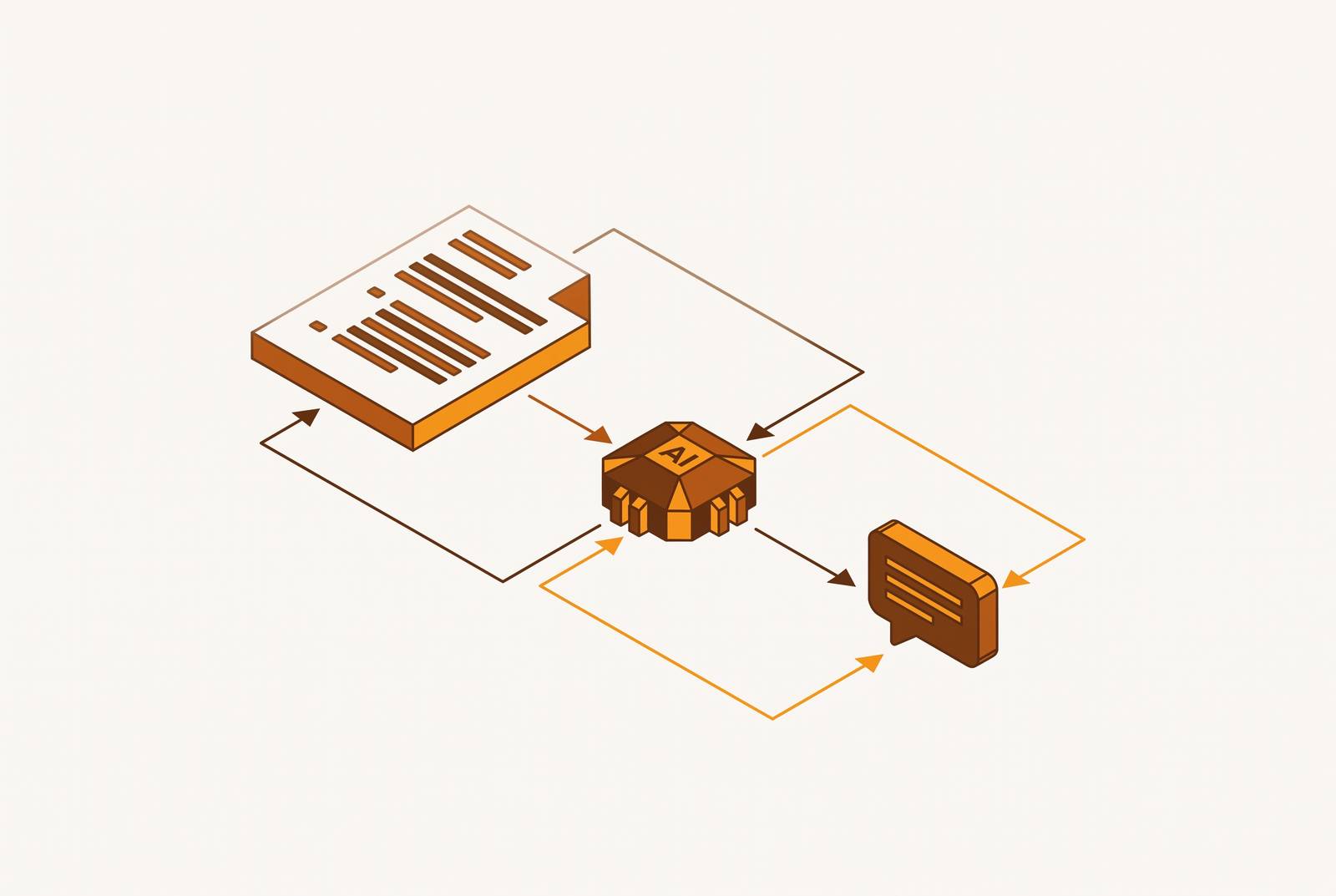
The system prompt is now the most precise brand artifact a company produces. It encodes, in machine-executable terms, exactly who a brand is, how it judges, and what it will never do. The argument that follows concerns how to write that document well.
Why the system prompt has become the primary brand document for customer-facing AI
Industry analysts note that by 2026, brands will not be known by their logos or slogans but by their AI: the agent that answers at 2am, handles the complaint, and executes the purchase. The claim is strong but the evidence supports it. Salesforce's Agentforce reached thousands of enterprise customers within months of full launch, and it resolves around 76 to 83 percent of customer conversations on its own help site without human escalation. At that volume, every word in the system prompt runs millions of times.
The consequence of this shift is structural. Brand management moves from visual identity teams to AI engineering teams, because the system prompt is where that shift lands in practice. Harvard Business Review frames the change as a new competitive paradigm: brands must now manage their reputation through agents that find, compare, and purchase on behalf of customers. The agent's instructions are the brand's competitive surface. When a customer meets a brand through an agent, the system prompt is what determines whether that meeting sounds like the brand or like a statistical average of every brand.
What goes wrong when system prompts treat brand voice as an afterthought
If the system prompt has vague or absent brand encoding, it does not produce neutral output. Every generation restarts from zero, defaulting to the statistical mean of their training data. If the prompt does not supply the brand, the model cannot recover it.
The copy failure mode is the most familiar. A prompt that says "write in a bold, innovative tone" produces inconsistent, generic output because the instruction carries no executable signal.
For agents that act rather than merely generate, the failure mode is more consequential. PwC's 2025 Future of Consumer Shopping Survey found that a majority of respondents said they need at least one safeguard to feel comfortable letting an AI agent purchase for them. When agents drift off-brand, they erode the trust that makes agentic commerce possible in the first place.
How to separate the foundational brand layer from the task layer in a system prompt
If you build a customer-facing system prompt, the most important structural decision is keeping the stable brand layer separate from the dynamic task layer. Conflating them is how brand context gets accidentally overwritten by task-specific instructions. The foundational brand layer holds what is stable: brand voice pillars and worldview, language rules including syntax and register and the words that never appear, claim boundaries covering what the brand asserts and explicitly does not assert, and taboos, the decisions settled long ago that are not renegotiated with every task. This layer is written once and updated intentionally. The task layer holds what is dynamic: the specific objective, whether support, sales, or onboarding. The asset or output being produced. The audience segment. And the output format and channel constraints. This layer is scoped to the specific deployment.
A single-block system prompt mixes the two, and the danger is structural rather than stylistic. A two-layer prompt makes the hierarchy explicit in the prompt's structure, not implicit in the reader's interpretation. Include brand voice with two or three sentence examples, spell out the formats allowed, and name the things the agent must never say.
Encoding brand voice with examples, not descriptions
Description of brand voice is lossy. Examples are not.
The three-example approach for support agents has a recognizable shape. One refund denial, one apology for a shipping delay, one cheerful FAQ deflection. Together they cover the emotional range and give the model an executable pattern rather than an abstract description. The same principle governs constraint specificity. Every clause eliminates a degree of freedom the model would otherwise fill arbitrarily. Specificity plays to the model's actual strength.
Writing guardrails that hold without making the agent brittle
A system prompt's prohibitions are as much a brand document as its voice instructions. When guardrails are written as blunt restrictions, the agent refuses too much and frustrates customers. Guardrails written with conditional logic produce agents that stay on-brand in the situations that actually occur.
The taboo layer belongs in the foundational block of the brand core: the competitor names the agent never mentions, the legal disclaimers it cannot make, the pricing it cannot verify, the product claims it cannot assert. These are decisions settled long ago, and they should appear as explicit named prohibitions rather than implicit expectations. If they're happy, ask for a review. This keeps the agent responsive without giving it unconstrained latitude.
There is a distinction to respect between the prompt's job and the platform's job. Safety architecture for customer-facing agents differs from internal agents, favoring tool whitelisting over blacklisting and strict sandbox isolation. The goal is precision, not restriction.
Structuring brand identity for machine consumption, not human reading
Traditional brand guidelines are incompatible with system prompts in their native form. The translation from human-readable PDF to machine-executable instruction is a distinct craft step that most teams skip. That is why system prompts drift even when guidelines exist.
The structural gap is that brand guidelines use qualitative language: "warm but authoritative," "premium but accessible." The machine-readable equivalents for each guideline category have a different character. Visual style becomes approved image categories, composition rules, and prohibited imagery specified as named constraints rather than adjectives.
The brand core that leads AI answers five things without room for interpretation: the position, what the brand stands for and explicitly does not; the language, its syntax, temperature, and the words that never appear; the imagery, its light, material, perspective, and the forbidden; the proof, what carries the claims; and the taboos.
How multi-brand and agency teams manage system prompt consistency across many agents
At agency and multi-brand scale, the system prompt problem becomes a governance problem. Without a defined hierarchy, individual agents drift from each other even when each is individually well-crafted. The cascade structure that mature teams use has three levels. The Central Brand Hub holds the Style Guide, the Brand Voice Profile with tagged system directives, the Glossary, and the Reference Documents. It is the master source. A department or region override layer then takes precedence over the account-level default for channel-specific or market-specific requirements. The hierarchy's purpose is precedence: when a department-level agent receives an override that contradicts the central brand voice, the hierarchy determines which wins. Without enforced precedence, the override wins silently.
Version control is the other requirement at this scale. Brand identity is a living system. A team that manages this by pasting guidelines into each prompt individually has not solved the governance problem. It has deferred it.
Why MCP changes what's possible for system prompt-based brand consistency
The Model Context Protocol converts brand context from a document the team pastes into prompts to a live resource agents query before generating anything. That is the difference between brand context that can drift and brand context that updates everywhere at once. MCP is an open standard introduced by Anthropic in November 2024 that standardizes how AI systems connect to external tools, data sources, and services. In December 2025, Anthropic donated MCP to the Agentic AI Foundation, a directed fund under the Linux Foundation, with Anthropic, Block, and OpenAI as co-founders and AWS, Google, Microsoft, Cloudflare, and Bloomberg as platinum members. The governance structure signals permanence.
The brand-specific value is direct. Instead of asking AI to generate content based on general knowledge, MCP enables the agent to query actual brand data, the style guide, previous campaigns, the approved asset library, before generating anything. Output becomes grounded in specific context rather than training data averages. For marketing operations teams managing connections between many tools, the difference is between a manageable burden and one that grows faster than the team can support.
The performance caution matters. Independent benchmarks show MCP adds token overhead and can reduce reliability on simple tasks compared to direct CLI. Teams should scope MCP for contexts where the governance benefit outweighs the overhead. This is where Rainbrand's Brand Skill concept is directly relevant: a versioned, retrievable representation of a brand's aesthetics, voice, references, and assets that any connected agent can pull via API or MCP-compatible environment. It is the infrastructure answer to the governance problem the previous section named. One canonical source of truth that lives in the workflow, accessible through Claude, Cursor, ChatGPT, and any MCP-compatible environment, so every downstream system inherits the latest version automatically.
What a well-structured on-brand system prompt actually looks like in production
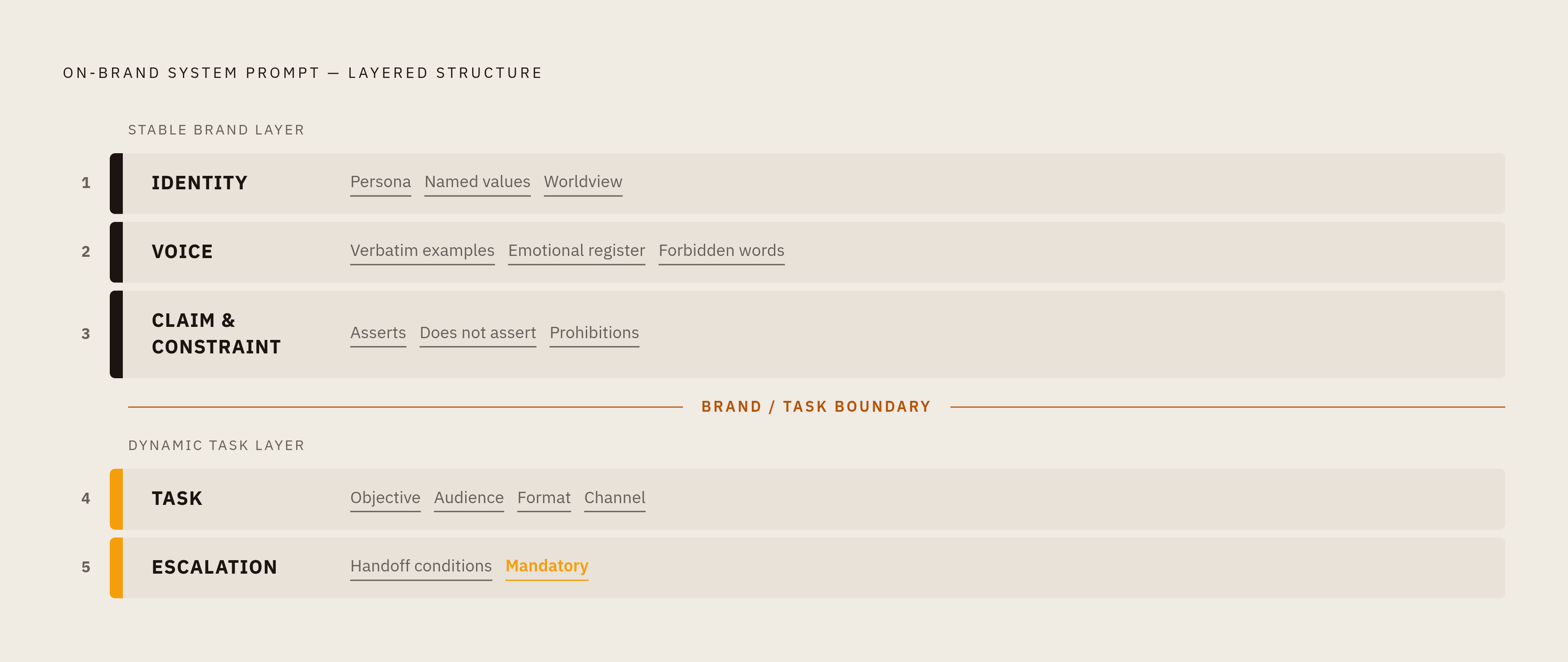
A production-grade, on-brand system prompt has a recognizable anatomy. It layers foundational brand identity, behavioral constraints, task parameters, and escalation logic in a specific order, and each layer does work the others cannot. The first block is identity: who the agent is, in the brand's own terms. Not "you are a helpful assistant" but the brand's specific persona, named values, and the worldview it holds. The second block is voice: two to three verbatim examples of correct output, one per emotional register, warm, firm, deflective, plus the word list of terms that never appear. The third block is claim and constraint: what the agent asserts, what it explicitly does not assert, and the named prohibitions, competitor names, unverifiable pricing, legal disclaimers. The fourth block is task: the specific objective, audience segment, output format, length range, and channel, dynamic and scoped to the deployment. The fifth block is escalation: the conditions under which the agent hands off, and to what, mandatory rather than optional. The anatomy orders these blocks so that stable material precedes dynamic material and brand precedes task.
The decomposition principle governs how the task block should be written for complex agent workflows. In a multi-step agent workflow, checking availability, holding a slot, taking payment, sending confirmation, the prompt should spell out the steps and make each independently testable. When Maven Clinic rebranded, Superside built a high-quality image selection, trained a custom AI image model on it, and delivered an on-brand Figma plugin for Maven's team. The output stayed on-brand because the brand context was encoded in the model and the tooling, not left to individual prompts.
Why ad-hoc prompt stuffing doesn't scale and what to build instead
The craft of writing an on-brand system prompt is necessary but not sufficient. Without version control, a shared source of truth, and update propagation, every agent in the organization drifts independently, and the problem scales faster than any team can manually manage. The stateless generation problem scales. The team that relies on individuals pasting brand guidelines into every prompt has built a system that degrades as volume grows. The version control imperative follows directly. A system where each agent carries its own static copy of brand context is a system where every update creates drift.
The infrastructure answer is a shared, versioned brand context layer, accessible via API or MCP to every agent in the organization. The system prompt author writes once to a canonical source, and every connected agent inherits the update. This is what Rainbrand's Brand Skill architecture is built to provide: one source of truth that lives in the workflow, versioned and updated the way code is. The system prompt is the most precise brand document a company can write, but its power depends on treating it as infrastructure rather than improvisation. Teams that version their brand context, propagate updates automatically, and give every agent access to the same canonical source are the ones whose AI output represents the brand rather than undermining it.