Persona-Layer Voice Encoding for Multi-Product Brands
AI-powered campaigns for multi-product brands need persona layers, not generic voice guidelines.
Most marketing teams running AI at scale know the feeling: the copy comes back clean, grammatically sound, hitting every point in the brief, and somehow belonging to nobody. It reads like a company that could sell insurance, running shoes, or dev tools with equal conviction, because it isn't actually committed to any of them. This piece argues that the failure is structural: AI systems default to a smoothed, average voice whenever they aren't given something specific to hold onto, and multi-product brands rarely give them anything specific. The brand brief might sit in one document, the visual system in a design tool, the AI draft in a third tool, and scheduling somewhere else. Each handoff between those tools is a place where the original voice can quietly drift, and the person doing the publishing often never read the brief that was supposed to prevent it.
A single-product company can absorb that drift. One voice, one audience, one set of rules to keep in mind, even if nobody formalizes them well. A multi-product brand doesn't get that luxury. Each product line has its own audience, its own register, and its own competitive position, so if you train a shared AI tool on all of them combined, you get a blended voice that fits none of the individual lines. A B2B infrastructure tool can end up sounding like a lifestyle app, or a flagship consumer product can pick up the dry technical cadence of the enterprise arm sitting next to it in the same training set.
That compounding problem gets sharper as the work shifts from humans using AI to AI agents acting on their own. Agents that run full campaign workflows end to end, qualify leads automatically, and repurpose a single piece of content across a dozen channels remove the one safeguard that used to catch voice drift before it shipped: a human editor reading the output before it went out. Once nobody is reading every draft, the smoothing has to be fixed by changing the system itself, not by editing individual sentences.
Why style guides cannot solve this at agent scale
The obvious fix is to write a better style guide. It doesn't work, and the reason has nothing to do with how well the guide is written. Static brand documents fail with AI agents because the agent has no reliable way to retrieve, interpret, and apply prose rules in the middle of a workflow unless someone hands those rules to it explicitly, every single time. A thirty-page PDF sitting in a shared drive is a file a human has to remember to open and paste in, and that dependency is what breaks at scale.
The content of most style guides makes this worse. They give a language model almost nothing to act on. A model trained across thousands of examples of "confident but approachable" content will produce a plausible average of all of them, not a specific brand's version of confident and approachable. A practitioner framework published in 2026 described this exact failure in a real case: the brief given to the model was about the topic the content needed to cover, not about who was supposedly saying it, so the model fell back on its own house voice, smooth, helpful, a little evangelical, and allergic to taking a real position on anything.
Pasting the full guidelines into every prompt is the manual patch for this, and it doesn't scale either. Every person on a team ends up keeping their own copy of that context, and those copies drift apart the moment the guidelines get updated anywhere but in every individual's prompt history. Agentic workflows make the problem worse still, because an agent that triggers and runs without a human starting it has no moment at which a brief could even get pasted in. For multi-product brands, this overhead multiplies directly with scale: maintaining a separate prompt preamble for each product line, for each workflow, for each tool, means the number of places voice can quietly break grows every time a new agent or channel gets added. None of this is a content problem that better writing fixes. It's a retrieval problem: brand identity has to become something a machine can look up on its own, rather than something a human has to remember to hand over.
What a layered persona architecture looks like in structure
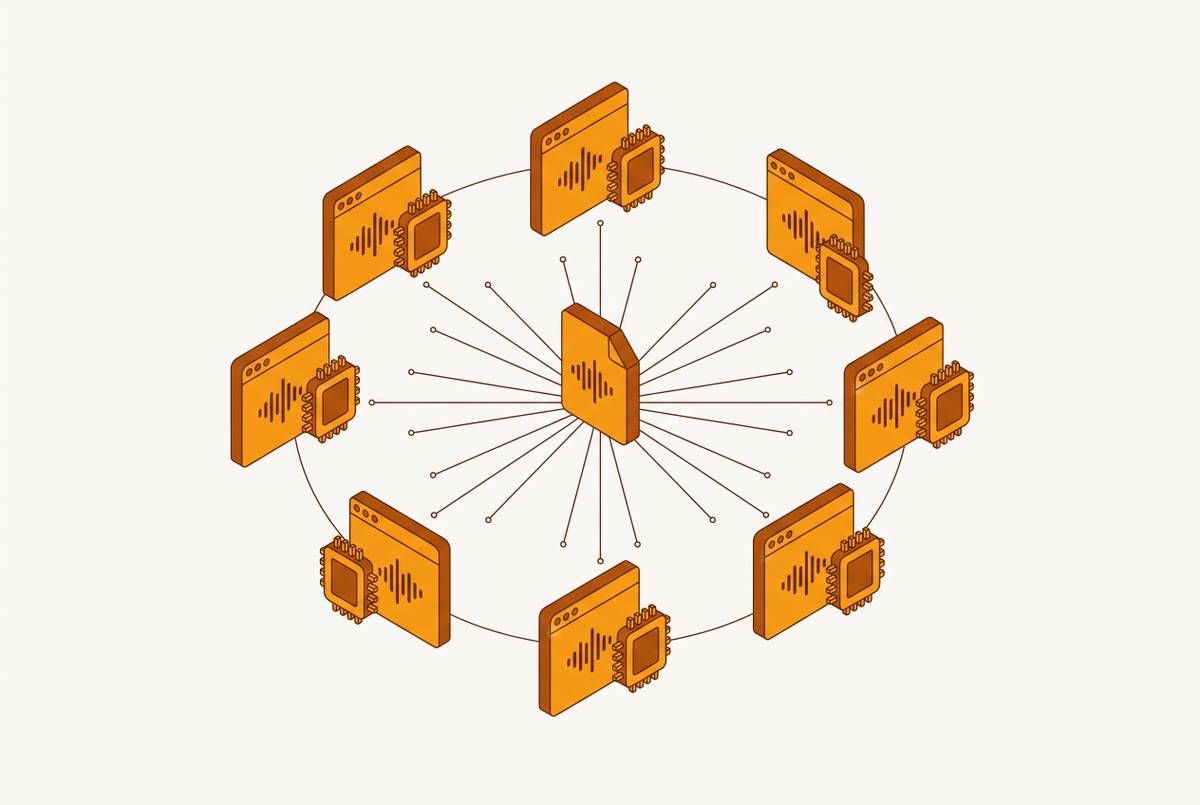
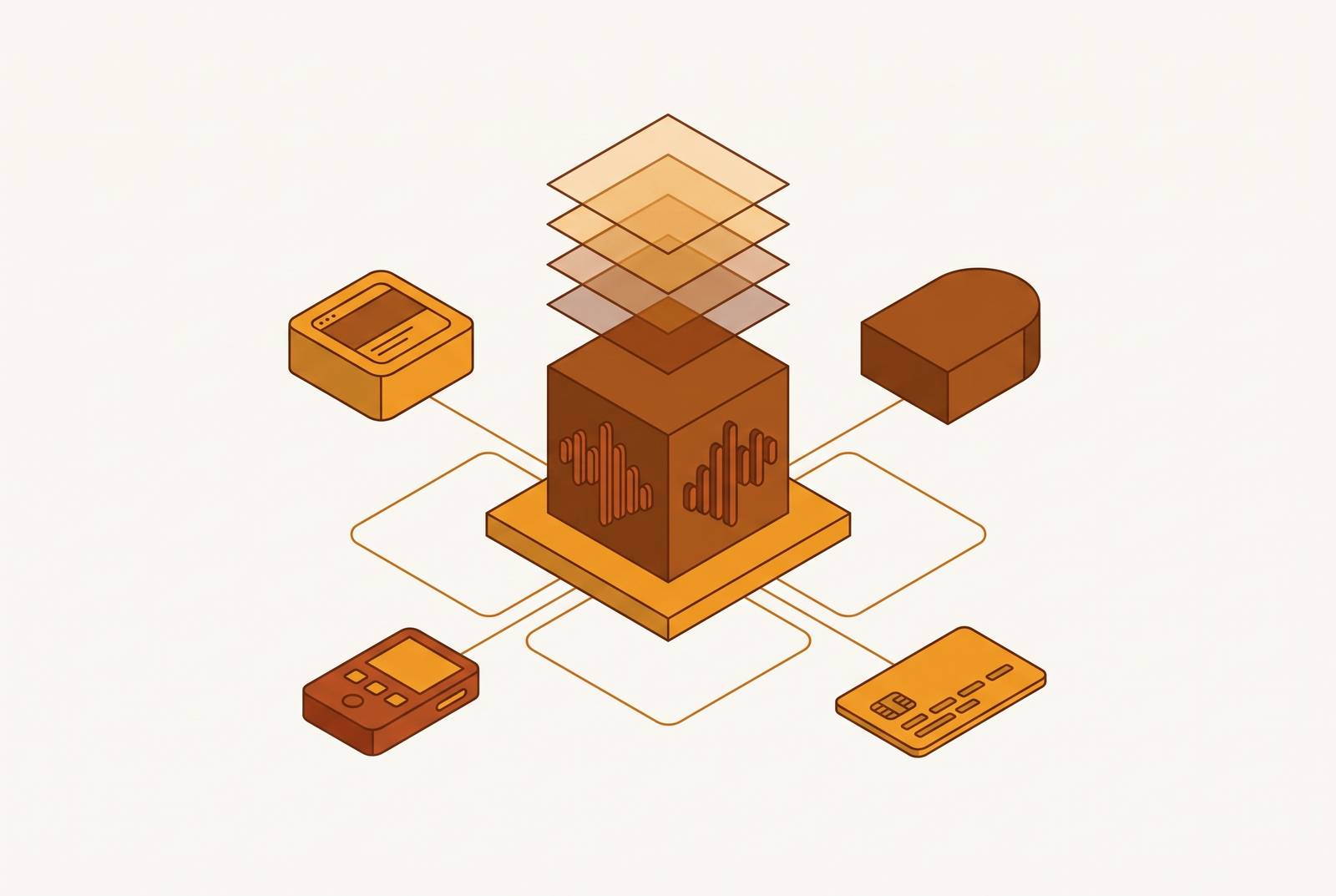
The fix is to stop treating brand voice as one prompt and start treating it as a hierarchy. At the top sits a parent brand context that every agent inherits regardless of which product it's working on, and layered on top of that sit distinct, retrievable sub-personas, one per product line, that narrow and adjust the parent voice for that specific audience.
The parent layer carries whatever stays true no matter which product is being represented: the core personality axes that never flex, such as always direct and never condescending; hard vocabulary rules naming the words the brand uses and the words it never uses under any circumstance; and structural defaults like sentence length range, how often the brand asks questions versus makes statements, and how it treats numbers and data in running text.
Each sub-persona layer carries only what belongs to one product line, nothing more. A B2B infrastructure product and a consumer app sitting under the same parent brand can share that same core personality, directness, the same refusal to condescend, while differing sharply in formality, technical depth, and how much expertise they assume the reader already has. Platform adjustments belong at this sub-persona level too, not the parent: the same product voice reads differently on LinkedIn than it does on Instagram, but both versions still inherit from the same sub-persona root, so neither drifts away from the product's core identity even as the format around it changes.
Isolation between these layers is a design requirement, not a nice-to-have. If you set up a workspace per brand or per product line, you keep training samples, approved content, and connected accounts separate, so nothing from one product line quietly bleeds into another's output. Sierra's Voice Personas framework offers the cleanest articulation of why this separation matters: a persona is not simply a tone directive sitting on top of a model, but a combination of voice, personality, and language-aware behavior working together as one coherent experience. So you can build the underlying agent once, then give it different personas for different brands, markets, and experiences, instead of rebuilding the whole system every time a new product line needs representation.
Encoding a sub-persona for machine consumption
A persona a machine can actually use is a structured set of inputs an agent can pull and apply at the moment it needs them, without a human sitting between the file and the output interpreting what it means.
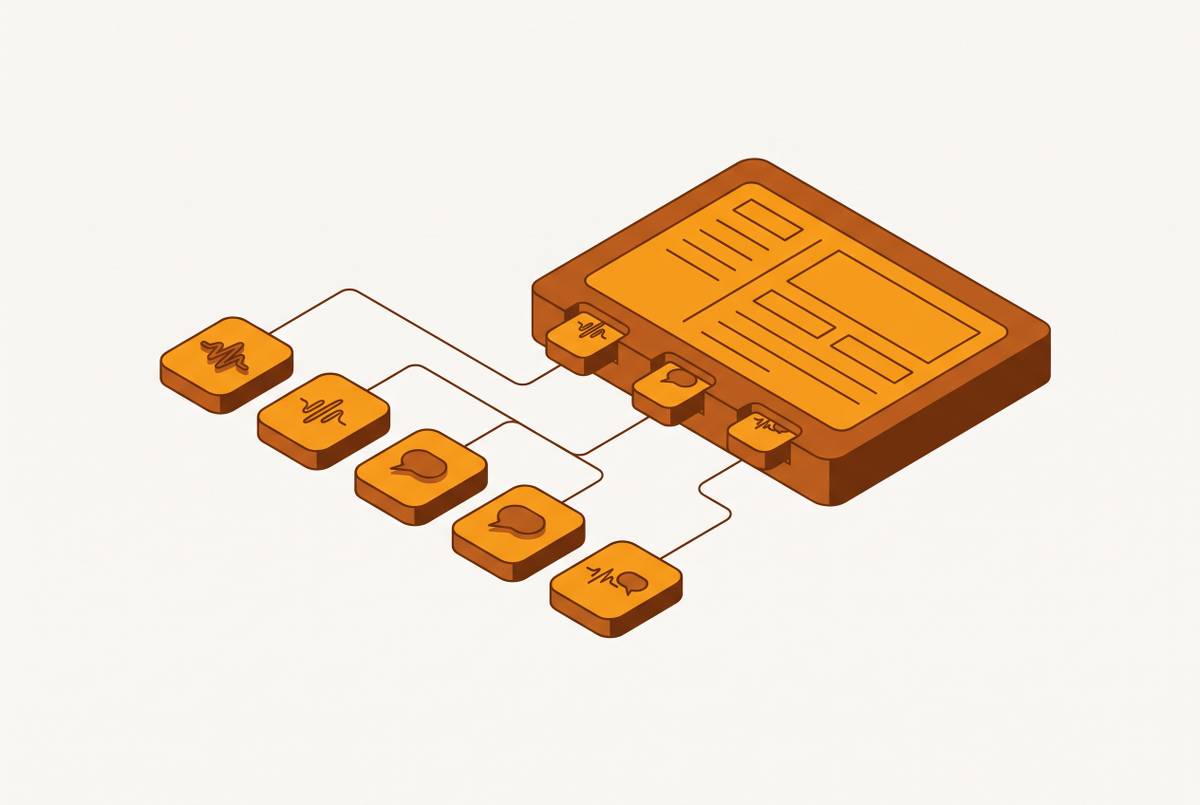
Three separate files do three separate jobs here, and you need to keep them separate because each one gets consumed in a different context by a different kind of task. A brand voice document covers tone, register, vocabulary rules, and side-by-side examples of sentences the brand would and wouldn't write, and this is what feeds writing and copy generation tasks specifically. A body-of-work reference, a curated set of the brand's strongest existing output in that product line's voice, teaches rhythm and sentence length and the words the brand reaches for before any written rule even states them. A visual design token spec, carrying exact color values, type scales, and spacing, feeds image generation and UI tasks; once an agent can read that token file, it can apply brand standards automatically to new output without a human reprompting it every time.
Quantified rules beat qualitative ones every time an agent is the one following them. Telling a system to use "a blue palette" invites guesswork. Specifying a primary cyan at a precise hex code, used at a defined proportion of the composition, paired with an accent color at its own defined proportion and a neutral background, gives the agent an exact instruction rather than an approximation of a descriptor, and the output reflects that precision. Negative examples carry more weight than positive ones in this context: showing a model sentences the brand would never write teaches it taste faster than any list of adjectives describing what it should sound like instead.
Voice-channel sub-personas extend this same logic into audio. NVIDIA's ADLR research describes PersonaPlex, a 7-billion-parameter full-duplex speech-to-speech model, using a hybrid system prompt made of two parts: a short audio sample that sets vocal characteristics and prosody, and a text prompt that sets role and context, processed together to hold a coherent persona through interruptions and mid-conversation barge-ins. The same dual-input principle applies to written copy: curated samples teach what prose rules alone can't fully specify. Encoding all of this in a machine-readable format like JSON or YAML, rather than paragraphs of description, cuts down on agent hallucination by giving the system exact values to match against instead of a prose description it has to interpret on its own, and that's what lets an agent generate on-brand output without a human checking every single asset for compliance.
What makes a persona retrievable at the protocol layer
A well-built persona file sitting on a shared drive is still a dead document until something lets every connected agent reach it the moment it needs brand context, not just the one tool it happened to be written for.
The Model Context Protocol is an open standard built to solve exactly this kind of connection problem. It gives AI models one consistent way to connect to external tools, data sources, and APIs through a client-server setup, and once a given source speaks MCP, any MCP-aware agent can reach it without custom integration code built for that specific pairing. An MCP server can expose three things directly useful to a brand system: tools the agent can call to take action, resources that hand over read-only context such as a product catalog or a persona spec, and prompts that encode reusable workflows the agent can run without being walked through them again.
For brand persona systems specifically, this protocol layer delivers something a shared drive full of files never could: brand guidelines don't need to be re-entered every time a team switches which AI tool it's using, because the persona lives on the server itself and every client that connects to it inherits the same context. So preferred formatting, platform defaults, vocabulary rules, and tagging conventions all stay consistent no matter which AI client or agent is doing the work that day. The AI agent should be easy to swap out, while the brand and publishing system underneath it stays durable and unchanged.
For multi-product brands, this is what makes per-product persona isolation practical at real scale, not just a theoretical nice-to-have. Each sub-persona becomes a versioned resource sitting on the server, and agents pull the correct one by product-line identifier, not by a human manually selecting the right file. If you update one sub-persona once, that update propagates automatically to every downstream agent drawing from it, so nobody has to track down and update every individual prompt preamble across every tool and workflow where that product's voice gets used.
Performance of the parent-plus-sub-persona model across written copy, voice agents, and image generation
This architecture isn't specific to written copy. The same layering logic, inherit from the parent, specialize in the sub-persona, governs voice agents and image generation too, and the failure mode in each case traces back to the same root problem: missing or imprecise context at the moment of generation.
In written copy, the feedback loop is what turns a static persona spec into a voice that actually compounds over time instead of staying frozen at whatever quality it started with. The practitioner framework describes the first two weeks working with a brand-trained AI system as a correction phase rather than a production phase: every edit made during that window functions as a training signal, and skipping that phase just means solving the same correction problems over and over on every new piece of output. Platform register adjustments, more formal on LinkedIn, shorter and warmer on Instagram, live inside the sub-persona layer and never require touching the parent: the core personality holds steady while the format shifts around it.
Voice agents face a harder test, because the persona has to survive in real time, under interruption, with no chance to revise before the words land. Sierra's Voice Personas, launched in August 2026, separates what an agent does from how it communicates, so one underlying agent can represent multiple brands or markets by switching which persona it's running. New capabilities in the Sierra Agent SDK let agents adjust pacing, respond naturally when a caller interrupts, and even switch voices or languages mid-conversation. NVIDIA's PersonaPlex, a 7-billion-parameter full-duplex model published in January 2026 and accepted at ICASSP 2026, demonstrates something closely related: a hybrid audio-plus-text system prompt can hold a defined persona through interruptions, backchannels, and barge-ins without the persona breaking down under that conversational noise. Sierra reports that differences in persona personality produce real differences in customer outcomes, with a natural voice paired to a well-built persona sharply increasing resolution rates for one deployed agent.
Image generation runs on the visual equivalent of the same file structure. A JSON-based design token file, carrying exact hex values, type scale, and spacing ratios, lets an agent apply brand standards to any new asset without a human re-prompting it each time, where a prose description of "our blue" would produce a different blue on every run. The main risk in AI image generation, altered product shapes, distorted logos, shifted color palettes, comes from the same root cause as voice drift in text: the system was never given precise enough visual context to anchor to. The fix in both modalities is identical. So you can replace vague description with exact, structured values the system can match against.
Operational changes for agencies and multi-brand teams managing this at volume
For an agency or an operator running several brands at once, this architecture does something a single-brand team doesn't need it to do: it turns brand isolation into something enforceable rather than something everyone just tries to remember to do carefully. If you back a workspace-per-brand model with versioned, protocol-served sub-personas, the system never hands a junior team member running a campaign for one client's product line context trained on a different client's voice.
That isolation is also what makes the economics work at volume. Without it, every new brand or product line added to an agency's roster means building a new prompt preamble, a new set of pasted guidelines, a new manual check on every piece of output, and that overhead scales linearly with headcount and client count in a way that eventually makes AI-assisted content more expensive to manage than it's worth. With a parent-plus-sub-persona structure served through a protocol layer, you add a new product line by adding a new versioned resource to the server, not by rebuilding a process. The brand and publishing system stays fixed. Only the persona being pulled from it changes.