Tone Guide Formats LLMs Actually Understand
Behavioral rules and examples help LLMs match your brand's actual voice.
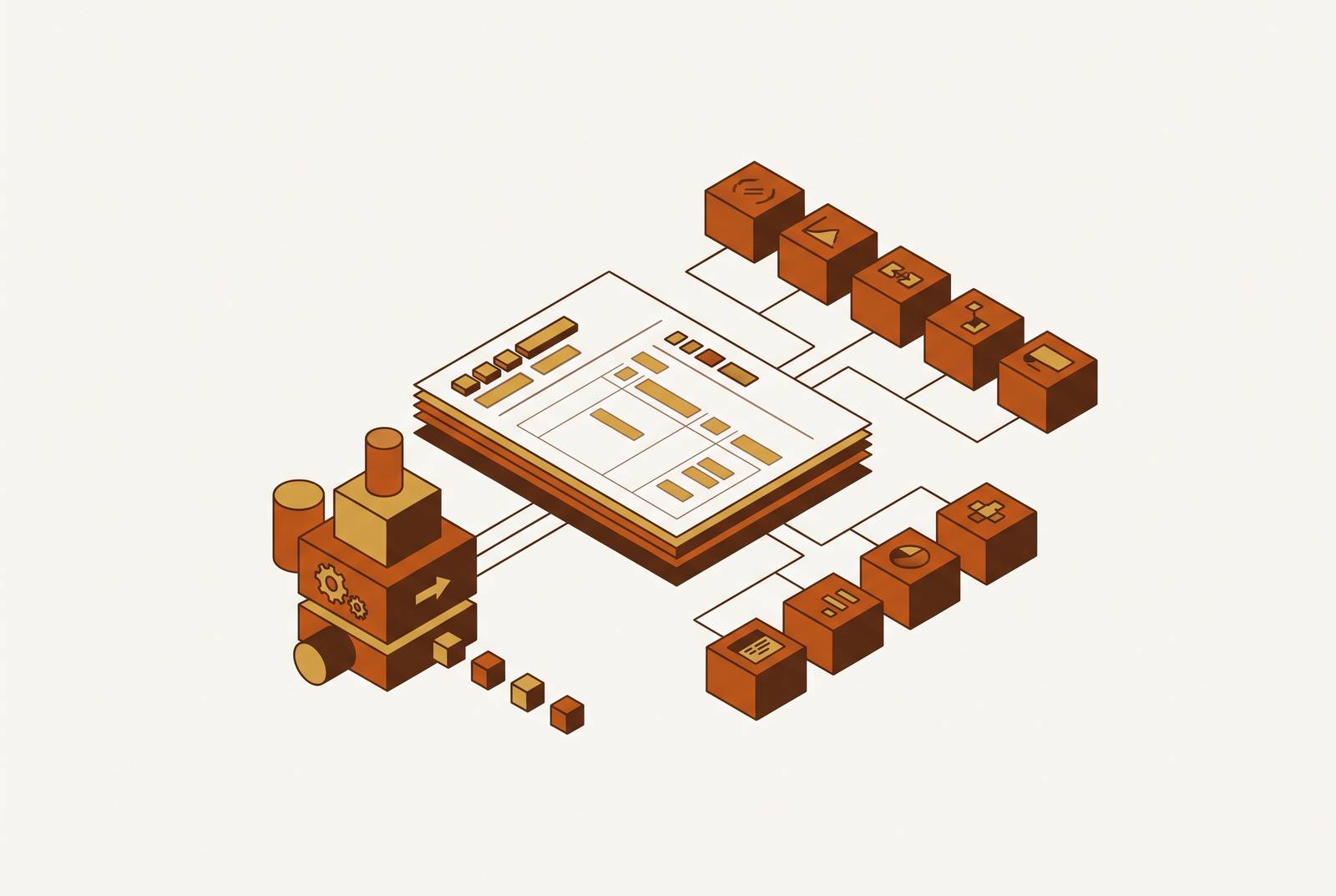
Most teams have read AI-generated copy that passes every grammar check and still feels wrong, polished sentences that somehow belong to no one. A deeper cause produces that mismatch: the tone guide behind the copy was written for a human to interpret, and an LLM was asked to execute it instead. A language model has no such scaffold to lean on. It has only the words on the page and the statistical patterns it learned during training, so when the instruction is vague, the output fills that vagueness with something generic. The result is copy that is technically correct and emotionally off, a drift that costs little on any single asset but compounds across every channel and every generated piece until the brand's voice has quietly eroded. Most organizations already have the raw material to fix this, scattered across positioning decks, messaging houses, and persona documents, but that material was never built to survive contact with a machine, and turning it into something a model can follow consistently is the actual task ahead.
How an LLM reads a tone signal
A language model does not understand what "confident" or "approachable" means the way a copywriter does. It reads text as sequences of tokens and learns which tokens tend to appear near each other in which contexts: short, declarative sentences correlate with energetic brands, long subordinate clauses correlate with formal ones, contractions correlate with conversational registers. Style instructions and example text work by nudging the model's next-token predictions toward a particular register for that one response; they don't retrain the model, they just shift the local odds. Formatting carries signal the same way prose does. Consistent heading structures, bullet patterns, disclaimer placement, even habitual punctuation choices all become part of the pattern a model associates with a brand and will reproduce if given the chance to learn it. Think of the model as a ghostwriter who has never met the client and will never sit in on a brand meeting. Handed a mood board and the word "bold," that ghostwriter guesses, and two different ghostwriters asked for the same mood will turn in two different manuscripts. Handed an actual page of the client's writing, the imitation gets close almost immediately. A tone guide written for a model is not a personality description. It functions as a set of constraints that narrows the enormous range of things a model could say down to the much smaller range that actually sounds like the brand.
Replacing adjectives with behavioral rules the model can execute
The first fix is mechanical: every personality adjective in the guide gets replaced with a rule that describes an observable action. "Our tone is confident" tells a model almost nothing, because confidence can mean short sentences, long ones, hedged claims stated flatly, or the absence of qualifiers. "Use active voice. Open with the answer, not a question. State outcomes before methods. Never hedge with 'we believe' when you can say 'we've seen.'" tells it what to do on every sentence it writes. The adjective describes a feeling; the rule describes an action, and only the action is something a model can check its own output against. This works best when voice gets split into independent dimensions, formality, sentence length, person, warmth, hedging, vocabulary, and each dimension gets its own rule rather than one adjective trying to cover all of them at once. "We never open with a rhetorical question" is a rule a model follows automatically. "We're approachable" is a target it has to guess at. Defining the boundary matters as much as defining the direction: "confident but not arrogant" tells a model exactly where confidence turns into something the brand doesn't want, a limit a bare "confident" can't convey. If the answer is no, the rule needs another pass before it earns its place in the document.
Building the vocabulary architecture: preferred terms, banned phrases, and the middle ground
Behavioral rules handle sentence structure and posture, but they don't give a model a concrete lexical boundary, and that boundary has to be built separately. A workable format uses three columns: terms the brand uses consistently, phrases that are banned because they signal generic or off-brand writing, and a middle list of words that are fine occasionally but become a tell when they show up in every third sentence. A hypothetical fintech brand might build something close to this:
| Preferred | Banned | Use sparingly | |---|---|---| | "see," "track," "cover" | "leverage," "seamless," "best-in-class" | "simple," "powerful" | | "we'll tell you" | "might," "maybe," "could potentially" | "innovative" | | plain numbers ("3 days") | "in today's fast-paced world" | "robust" |
The banned column is where real drift gets caught. Instead of an instruction like "we're bold but approachable," a brief that says "use direct verbs, avoid hedge words like 'might' or 'maybe,' and write at a defined reading level" gives a model something it can actually enforce sentence by sentence. Generic AI output has recognizable tells: em-dash overuse, "in today's fast-paced world," relentless positivity, three-item lists appearing everywhere whether or not three items make sense, and a deliberate vocabulary list is how a brand writes its way out of that register. Company-level vocabulary needs to stay separate from campaign-level vocabulary, because when the two blur, a model treats a slogan built for one quarter's launch as a permanent brand rule and starts reproducing it in support replies and pricing pages where it has no business appearing. Formatting choices belong in this architecture too: heading conventions, bullet use, where a call to action sits in a page, all of it needs to be written down rather than assumed, because a model reads structure as readily as it reads words.
Why annotated examples carry more signal than rules alone
Handed a single page of a brand's actual writing, a model's imitation tightens almost immediately, because models learn voice by pattern-matching prose, not by parsing a list of instructions. A short passage of real, on-brand text, something in the range of 80 to 150 words, gives the model a concrete target, carrying more usable signal than a paragraph of adjectives ever could. The contrast is visible in how differently the same fact can land. Stated directly, "the product ships in three days" is just a fact. Run through a rule set alone, a model might render it as "we ship in three days," correct but unremarkable. Shown an annotated example of the brand's actual style first, that same fact might come back as "three days, no tracking number you have to hunt for," because the example taught the model the brand's habit of naming the small friction it removes. One example can read as an outlier the model might overfit to. Two or three examples let it find the pattern underneath the surface variation: a fixed core, sentence rhythm, structure, posture, against flexible content that changes with each message. The most reliable system prompt carries both pieces at once: the explicit rules that pin down what the brand never does, and one or two example passages that carry the feel no rule set captures on its own. Together they define the voice a single time so that every message generated afterward inherits it without re-explaining it.
Anti-patterns and negative examples: what to exclude is as important as what to include
A tone guide that only shows a model what to do leaves it with no way to recognize writing that is well-crafted but still wrong for the brand, and that gap has to be closed with negative examples, not left to inference. A social post that went viral because it took a sharper, edgier tone than the brand normally uses is exactly the kind of content that needs to be flagged and set aside in an anti-pattern list, because a model cannot tell "effective but off-brand" apart from "on-brand" unless something tells it explicitly. Pairing correct and incorrect examples side by side teaches a model the boundary faster than either one alone, because the contrast shows where the line actually sits rather than leaving the model to infer it from a single direction. The content audit earns its place in the process here: pulling only current, accurate material into the guide matters because a two-year-old landing page built around outdated positioning will teach a model the wrong lessons just as readily as a well-chosen example teaches the right ones. The anti-pattern list is the half of the example set that keeps the good half from being misread.
Tone scales and conditional switching for brands that write in more than one register
A flat tone guide assumes every piece of content the brand produces should sound the same, and that assumption breaks the moment a brand needs to say something different in a crisis than it says in a product launch. Numerical anchors solve part of this problem: a product announcement might sit high on an energy scale and lower on a formality scale, while a security advisory flips both numbers, formal and low-energy, and giving a model that kind of numerical anchor prevents the drift where every piece of content ends up sounding identically enthusiastic regardless of what it's actually about. The clearest way to encode the switch itself is a "We Always / We Never / When X, adopt Y" structure: incident communications must stay transparent and free of marketing language, launch campaigns are expected to carry real excitement, and writing both rules into the same document tells a model exactly when to apply which register based on the situation at hand. The same logic holds for brands addressing more than one audience. A healthcare brand might specify that any prompt referencing clinicians should produce a formal, evidence-based tone, while any prompt mentioning patients or appointment scheduling should shift to something warmer and more accessible, and that branching needs to be written out explicitly rather than assumed to be obvious from the subject matter. Voice and tone aren't the same thing, and a guide that treats them as interchangeable will cause a model to either flatten every piece into one register or lose the brand's underlying consistency while chasing context. Voice is the personality that holds steady across everything the brand writes. Tone is the adjustment that shifts by situation, channel, and audience, and keeping those two layers distinct in the guide is what lets a model vary one while preserving the other.
Measuring whether the guide is working, not just feeling right
A tone guide that can't be scored can't be improved, and that single fact is what separates a repeatable house style from an endless cycle of manual correction. A workable scorecard asks a short list of concrete questions: is the formality level correct for this context, are banned words absent, is the length within range, is the conditional register the one the situation calls for. Early on, that scoring can be done by hand against a handful of generated samples; later, a model can act as its own style judge, checking new output against the same scorecard before it ever reaches a person. None of this holds still, because brand identity isn't a static artifact. New product lines, new markets, a repositioning, any of these should trigger an update to both the written rules and the curated example corpus, so that every model downstream inherits the current version of the brand. The voice showing up in a brand's performance ads is often more direct and transactional than the voice described in its own brand frameworks, a discrepancy that measurement reveals and that has to be resolved deliberately rather than left for the model to average out on its own. Governance questions sit behind all of this: who approves changes to the guide, who owns the example corpus, and what event triggers a re-audit. Answering those questions is what turns the tone guide from a document someone wrote once into infrastructure the brand can actually depend on as it grows.
Brand Context Infrastructure and the Prompt Loop
A tone guide built with every layer described above, behavioral rules, vocabulary architecture, annotated examples, anti-patterns, conditional registers, a measurement process, still runs into a scaling problem the moment more than one person or tool needs to use it. Pasted manually into every session by every team member, that guide becomes a siloed copy with no guarantee it matches the current version, and as the number of agents, tools, and writers touching brand content grows, that manual repetition turns into the actual bottleneck. The Model Context Protocol offers an infrastructure-level answer to that problem: an MCP server exposes a brand's real context, its voice rules, vocabulary constraints, conditional registers, annotated examples, as something any compatible tool can query while it's generating output, rather than something a person has to remember to paste in beforehand. A brand that exposes its tone guide this way changes what the guide is. Every connected tool checks it automatically as a source, making each one a brand-accurate executor without a person standing over every step. Rainbrand is built for exactly this layer of the problem: it takes a brand's existing assets, websites, social media, internal files, and turns them into a versioned Brand Skill that agents, products, and workflows can pull from via API or MCP, so the tone guide built using the framework in this article becomes the one source every downstream system draws from, rather than a document copied inconsistently across a dozen prompts. Agencies and multi-product operators get a further benefit from this structure: each Brand Skill stays distinct, so the rules governing one client's voice have no path into another client's output. And when the brand's voice changes, a repositioning, a new product line, an update to the Brand Skill propagates to every connected agent at once, the same versioned-update logic that already keeps software deployments current, applied this time to the brand's own voice.
GuideBrand Voice Examples: Six Voices Written So People and AI Can Use Them