Scaling Content Production Without Scaling Brand Drift
Structured brand context in shared systems prevents drift better than prompts alone.

To produce more content without more brand drift, teams need shared, structured brand context that every agent uses to create and review the work. Detecting when AI output drifts off-brand means comparing it against explicit criteria for voice, visual standards, audience, and behavioral constraints. At production volume, those criteria must function as versioned infrastructure.
Why volume alone doesn't cause brand drift — missing shared context does
A team puts out more content, its performance metrics look good, and each asset looks polished. Yet its channels begin to sound like different organizations. Brand drift can occur even with strong writing and design. Agents can complete their assigned tasks successfully while making incompatible choices about what the brand means.
Three mechanisms explain how this happens in agentic systems. Decision diffusion means no single agent is responsible for how the output as a whole affects the brand. Temporal collapse means agents lose the organizational memory that gives brand choices their meaning, while accountability dissolution means no named role watches for identity drift as it builds up. Conventional monitoring can miss the change entirely.
The intuitive response is to demand better prompts, stricter review, or slower production. Drift is a predictable result of agents doing their jobs without the shared reference that would make those jobs brand-safe.
Why prompt engineering fails as a consistency strategy at production volume
Early workflows made generic content, made up color and typography choices, and left people with a lot to fix. Teams then used long prompts with brand guidelines copied into them. Output improved, but context-window limits, security risks, and the work of maintaining instructions across clients and creators constrained that approach. The correction remained attached to each interaction.
Agents face unclear queries, emotional users, goals that clash, and edge cases that a prompt written ahead of time cannot fully account for. When guidance says too little about these cases, agents can fall back on generic defaults. A longer prompt does not resolve that structural gap. Agents need access to decision frameworks that apply when the task departs from the expected script.
Isolated prompting also fails at coordination. Each agent or team member enters a slightly different version of the rules, creating separate copies of what should be shared guidance. Improving one copy does not improve the others. Programmatically embedding brand rules into the workflow addresses a different problem from prompt refinement, namely making the same authority available across production.
What structured brand context actually contains — and why the format matters
A human-facing brand book describes the brand for someone capable of interpreting it. Machine-readable brand context must also explain when a rule applies, why it exists, what acceptable execution looks like, and what must never happen. Agents need decision logic. Without that logic, even detailed guidance leaves them to approximate the intended result.
The practical translation turns colors, typography rules, spacing scales, and voice guidelines into structured data defined through tokens and schemas. These give agents precise parameters. Design tokens make the distinction concrete. When a visual element is defined through a token, updating that token propagates to future assets that use it. Editing a guideline in a PDF does not propagate the change.
Version-controlled templates build on this by showing what changed, allowing rollback, and keeping separate contexts for sub-brands or campaigns. But visual precision is only part of the requirement. Voice also depends on intent and judgment. An agentic brand context therefore includes decision frameworks that follow brand values and behavioral constraints for cases where there is no scripted answer.
Why brand context belongs in infrastructure, not in the prompt window
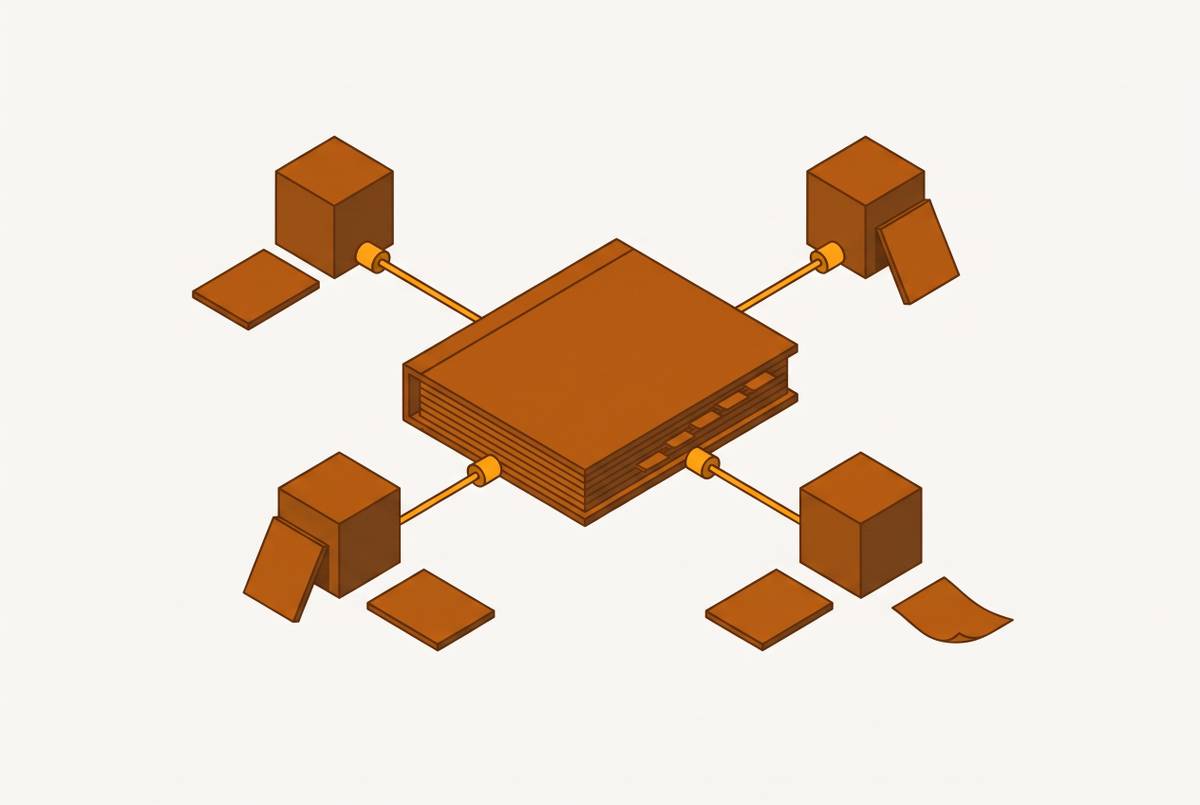
Brand context must be a runtime dependency that agents query before generating. Its reliability cannot depend on whether someone remembers to paste the right instructions. A central source that holds voice guidelines, visual standards, and audience definitions gives every connected agent access to those rules. Consistency then depends on the workflow rather than individual diligence. That is the architectural shift.
The comparison with configuration management is direct. Configuration moved out of individual scripts into version-controlled systems because separately maintained copies were difficult to coordinate. Prompt-time brand guidance has the same weakness. It is re-entered manually, varies across agents, and can disappear between sessions, whereas infrastructure-level context is queried automatically and maintained in one place.
This requirement also determines when governance belongs in the system. Adding rules after deployment is more expensive than building them into the workflow, because teams must then reverse drift already spread across production. Brand changes make the distinction sharper still. When identity changes, connected agents must work from the new definition without waiting for updated documents to reach every operator. Central maintenance and versioning are therefore part of brand enforcement.
How MCP connects agents to shared brand context at runtime
Model Context Protocol, or MCP, gives agents a way to connect to live brand sources. Instead of relying only on general knowledge and instructions embedded in a prompt, an agent can query style guides, reference approved assets, and retrieve campaign history before generating. The source becomes part of the task. This closes the operational gap between centrally maintained guidance and the agents expected to apply it.
Anthropic open-sourced MCP on November 25, 2024, with Block and Apollo among its early adopters. The ecosystem includes Claude, ChatGPT, Cursor, Visual Studio Code, and thousands of MCP servers, including connections to Notion and Google Drive. The pattern extends to creative production. Claude can call Higgsfield MCP to generate images and video clips while the prompt, brand context, and assets remain in the same conversation, so the context travels with the task without being re-entered.
Bloomberg used MCP to close the “productionization gap” between a working GenAI demonstration and a deployable, compliant application, cutting experimentation cycles from weeks to minutes. Forbes doubled landing-page conversion rates through Knak’s no-code platform, demonstrating marketing workflow improvement without providing evidence of MCP deployment.
Technical leaders identify security concerns as their top obstacle to MCP adoption. Those concerns require careful infrastructure design, while reverting to copied prompts distributes data-exposure risk across individual sessions.
What a multi-agent brand workflow looks like when context is shared
Shared context begins operating at brief intake. An agent receives the task and queries the brand source for the applicable logo variant, typography rules, palette, imagery direction, and voice guidance. It builds a task-specific brief from that reference. Creative agents then produce channel-specific assets against the brief while continuing to reference the same source, rather than independently interpreting separate copies of the guidelines.
The next stage separates creation from enforcement. An agent assigned to review checks the output against brand standards before a human sees it. The “Brand Guardian” pattern gives this responsibility to a specialized agent whose sole role is evaluating drafts. If a creator agent breaks tone or uses a banned element, the guardian routes the draft back for revision. Its authority comes from the shared standards, regardless of who produced the asset.
Human review can then follow the significance of the work. Automated checks cover compliance, peers review standard assets, and senior staff review flagship work, with brand context setting out which work gets which review. This also creates measurable production criteria. Color accuracy rates, typography compliance, and voice alignment scores make consistency something the pipeline can assess and improve, rather than a general aspiration attached to the final review.
Why multi-brand agencies face the steepest version of this problem
For an agency, shared context is not enough. Each client requires an isolated brand context within the shared production architecture. When different clients use the same generation surface without that separation, their palettes, typography, logos, and voices can begin to converge. The failure crosses account boundaries. An architecture that improves consistency for one brand can therefore spread contamination if it does not preserve the boundaries between brands.
The operational requirement is governance before generation. Agencies should establish one context per client before producing assets, so the work begins inside the correct brand system. That context must remain distinct throughout the pipeline.
New York’s synthetic performer rule took effect June 9, 2026, and sets escalating fines for repeat violations, with responsibility falling on the advertiser or agency that produced the ad. For agencies producing covered content, governance must therefore encompass the production and approval system. The structural goal is to establish the controls before output scales.
What detecting off-brand AI output actually requires
To detect off-brand AI output, reviewers need to check it against the same structured context used to create it. A reviewer’s memory of the guidelines is not an equivalent reference. If generation uses explicit rules but evaluation relies on intuition, the workflow reintroduces inconsistency at its final stage. Review must have access to queryable standards. Otherwise, “close enough” becomes an unrecorded substitute for compliance.
Visual review checks color accuracy and typography compliance, while voice review evaluates alignment with tone, audience, and behavioral constraints. File specifications and accessibility form additional checks. An asset can pass technical checks and still express the wrong intent. Separating these dimensions makes the review more precise than a single judgment about overall quality.
The detection system belongs inside the approval workflow. Automated checks handle defined brand and technical requirements, filtering violations before human review. People can then focus on creative quality, how well the work fits the strategy, and high-stakes work, without having to check the basics over and over. This applies the discipline expected of a traditional photoshoot or design brief to AI-generated assets while making that discipline repeatable across many outputs.
Making brand context a living system that agents always work from the current version
Centralized context can still become stale. Agents may faithfully follow an outdated definition, reproducing a slower form of the drift the infrastructure was intended to prevent. A visual refresh, tone update, or new campaign framework must therefore propagate to every connected agent through the maintained source. Version control makes that change auditable. It also preserves the history needed to understand which definition changed and to roll it back when necessary.
Keeping the source current requires explicit ownership. Teams should define who updates brand context, what triggers a version change, and where human approval is required before an update propagates. Each workflow stage needs named responsibility for commissioning, performing, checking, and approving the work. Escalation rules must be written down. This prevents autonomy from obscuring responsibility for the brand definition itself.
Measurement belongs in that governance from the start. Brand consistency scores and engagement metrics should be tracked from day one, because performance alone can conceal identity drift. Scaling content production is therefore a systems challenge. Brand context needs the same ownership, versioning, and shared access that teams already expect for critical code and configuration.