Measuring Brand Consistency Across AI-Generated Content Programs
Scoring AI content against one live brand reference beats spot-checking.

To detect when AI output drifts off-brand, visual, verbal, and contextual signals must be checked against one current, machine-readable brand reference. Across AI-generated content programs, those checks should produce compliance scores and review evidence, with routine passes automated and uncertain cases escalated to people. The prerequisite is shared brand context, because a score cannot establish consistency when different tools apply different rules.
Why manual brand review breaks down at AI content volumes
Content production tasks that once took days now finish in minutes, and resulting asset volumes have grown from dozens to thousands per month. Review capacity has not expanded at the same pace. The resulting governance gap is structural, because producing another asset is now much easier than giving it a careful human assessment. Faster spot-checking cannot provide coverage of everything that ships.
Drift accumulates through small departures. A logo stretches, a palette shifts, campaign tone wanders, or an outdated product description survives on a secondary channel. Each deviation may appear minor in isolation. Together, they weaken recognizability across the content program. Review before publication catches this only in assets a person sees, so relying on people to check the work leaves a growing share of output without structured evaluation.
What brand consistency actually means across visual, verbal, and contextual dimensions
Brand consistency is recognizability across formats. Measurement therefore needs to distinguish what remains fixed from what can change appropriately. The visual dimension includes logos, color palettes, typography, and imagery style, with many elements comparable against specified values. The verbal dimension includes tone, approved vocabulary, banned words, messaging priorities, and the terms used to describe products and services. These dimensions establish what the brand looks and sounds like.
Context sets which attributes an asset should have. It includes channel, audience, campaign type, and funnel stage, so a LinkedIn post and a TikTok reel should feel like the same brand without becoming identical content. This distinction also applies beyond assets the company directly publishes. AI-mediated discovery creates another surface where websites, social profiles, reviews, and directories contribute to generated brand descriptions. Conflicting information across those sources can produce inaccurate or incomplete answers, making consistency a commercial concern as well as a question of presentation.
Why static brand documents produce inconsistent AI output
Documents written for people do not express brand rules as machine-readable constraints. A PDF might instruct a team to use its boldest tone for launch campaigns. A machine needs explicit logic connecting campaign_type=launch with tone=bold and vocabulary=approved_launch_list.
A lengthy document also leaves priorities unclear. An AI tool given a 60-page PDF has no clear structure that separates non-negotiable rules from what can change within set limits by channel, audience, or funnel stage. Assets create a similar problem when their restrictions are detached from the files. A logo without metadata does not tell an agent its minimum clear space or whether dark backgrounds are prohibited.
Existing guidelines can become structured fields expressed through JSON, design tokens, asset metadata, explicit rule logic, and decision trees for conflicts. This preserves the underlying brand decisions while making their application testable. Measurement then has a defined reference instead of another interpretation of descriptive prose.
How a single shared brand context prevents measurement from becoming a guessing game
Structured rules still fail as a common standard when every team keeps a separate copy. Different agents may produce internally compliant work against incompatible versions of the brand. A live connection addresses this version problem. An MCP link or canonical machine-readable URL lets compatible tools query shared context directly, avoiding documents that can become stale.
Anthropic open-sourced Model Context Protocol in November 2024, and the protocol is now an open standard under the Linux Foundation’s Agentic AI Foundation. MCP lets AI agents securely connect to external tools, databases, and APIs through a single interface. For brand teams, a server can expose voice rules, visual identity, approved assets, positioning, and permitted or prohibited usage. Through that connection, agents can get the context before they generate content.
Production deployments illustrate the range of this infrastructure. Adobe Marketo Engage launched its MCP server in April 2026, covering operations including forms, programs, smart campaigns, leads, and emails. Dash Social announced its MCP integration in August 2026, bringing proprietary brand intelligence into workflows including ChatGPT and Claude. Zapier’s MCP server connects to a wide range of apps and actions. In multi-agent workflows, shared context serves a further purpose, providing persistent state across pipeline steps where individual agent memory is transient.
The measurable signals of visual brand consistency
Visual consistency is the most objective place to start. Many reference values are exact, so deviation can be computed. Color checks compare sampled brand and product colors in finished assets with specified HEX, RGB, or Pantone values using a Delta E tolerance. Delta E measures perceptual color distance. Tolerances can be tighter for products and packaging than for backgrounds and secondary elements, reflecting the different constraints attached to those uses.
Typography requires more than identifying a general type category. The measurable criteria are approved typefaces, weights, and size hierarchies, because an unapproved sans-serif remains a departure even when it resembles the intended font. Logo checks likewise cover distinct requirements, including minimum size, clear space, prohibited backgrounds, and approved variations. Attaching those rules as asset metadata gives automated evaluation an explicit basis for checking generated output.
Imagery style requires a less exact comparison. A vision model can compare photography mood, illustration type, and recurring visual patterns with an approved reference library. A practical baseline audit samples assets shipped over a defined period and uses a vision model to generate a quantified visual drift score. Subsequent output can then be assessed against that baseline.
How to detect when AI-generated copy drifts off-brand
Verbal consistency becomes measurable when voice is expressed as specific, testable rules. Personality descriptions alone do not provide a reliable rubric. Approved company and product descriptions establish the terms copy should use, rather than accepting synonyms or paraphrases with different connotations. This is particularly useful where AI otherwise defaults to generic formulations. The vocabulary standard needs the same explicitness as a set of color tokens.
Tone can then be checked against a set of defined criteria. These include formality level, sentence length patterns, first- versus second-person usage, and the presence of banned words or phrases. Each criterion gives reviewers something narrower to evaluate than whether the writing sounds right. A rubric-based consistency score expresses adherence to those verbal standards, while revision rate measures the share of AI-generated copy requiring major editing or replacement before publication.
Comparing work across channels tests whether assets that pass on their own also work well together. A paid social ad and its landing page should preserve the same core claim, offer framing, and brand personality, even when different teams manage them. Third-party descriptions introduce a related exposure in AI-mediated discovery. When descriptions in directories, review platforms, and social profiles conflict, AI systems can give incomplete or inaccurate accounts of the brand.
The measurable signals of contextual brand consistency
An asset can pass visual and verbal checks yet apply the wrong rules. Launch-campaign vocabulary may be approved in general but inappropriate for a retention-stage email. Professional tone may likewise be valid for one channel and unsuitable for another. Contextual measurement tests rule selection. Without that distinction, a strong compliance score can conceal a poor fit.
Explicit conditions provide the missing reference. A rule such as if channel=LinkedIn, tone=professional allows a channel-specific audit to compare output with the relevant requirements. The same principle applies to campaign type, audience, and funnel stage. Agency and multi-brand operations add another boundary, because clients have separate context rules. When two clients share a generation environment that keeps their context together, drift can spread from one brand into another client’s account.
Building a review workflow that runs at AI content speed
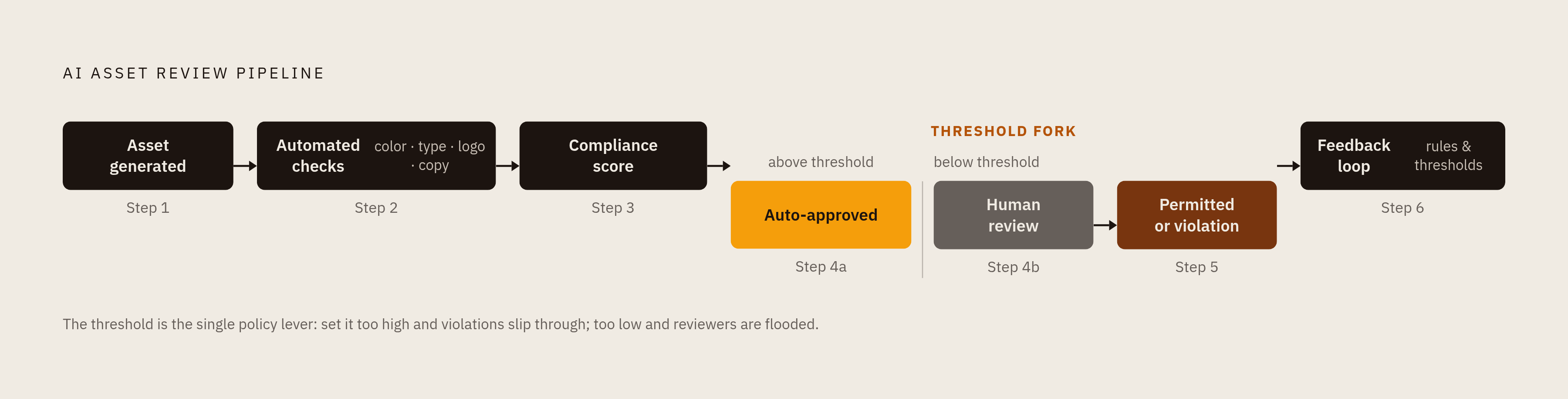
A scalable review workflow separates automatic approval from human escalation. The dividing line is a defined compliance threshold. Vision models and rule-based checks first check whether color, typography, logo usage, and vocabulary follow the rules. They produce a compliance score for each asset against the applicable standards. Assets above the threshold are auto-approved, while those below it move to human review.
The threshold is a policy decision. Too high, and it floods reviewers with work. Too low, and borderline assets ship without anyone checking them. Its purpose is to concentrate human attention on genuine edge cases while allowing straightforward compliance checks to run at production speed. The score must therefore be tied to clear criteria that explain the verdict.
Human reviewers assess the selected rules’ fit for the channel and audience and classify departures as permitted variation or violations. The workflow should provide evidence for each check. That evidence connects the review decision to the same standard used in the automated pass, making the handoff an evaluation of defined requirements.
Downstream measurement tests whether following the rules within the company is linked to business results. Brand lift studies comparing AI brand kit campaigns against control groups can provide that confirmation. Revision rate serves a different, upstream purpose. A rising share of assets requiring major edits signals that the automated pass may be miscalibrated or the brand context incomplete. The feedback loop should therefore lead back to the rules and thresholds.
Keeping brand context current so measurement scores stay valid over time
A consistency score is only as valid as its reference. When guidelines change but agents continue drawing from an older standard, compliant output and on-brand output diverge. A high score can then conceal an obsolete decision. The measurement baseline must update with the brand, so an asset previously approved against last quarter’s color tokens is assessed against this quarter’s refresh when the current standard applies.
Brand identity should therefore be versioned like code. Each change becomes an update that connected agents and products receive from the shared source, rather than a revised document distributed manually across teams. This keeps generation and evaluation aligned with the same reference. For agencies and multi-brand operators, version changes also need isolation by client, because each brand has its own update cadence. Otherwise, scores can conflate intentional change with unintended drift.
The number of conflicting or outdated brand references found during an audit measures how effectively version control is working, and a rising count signals unreliable propagation. This maintenance work gives the earlier compliance checks their continuing validity. With current context shared across agents and products, and evidence available for each review check, brand measurement shifts from periodic spot-checks to a continuous signal of whether the system is working.