Repurposing Existing Content With AI While Preserving Brand Voice
Structured, persistent brand context keeps AI repurposing on-voice.
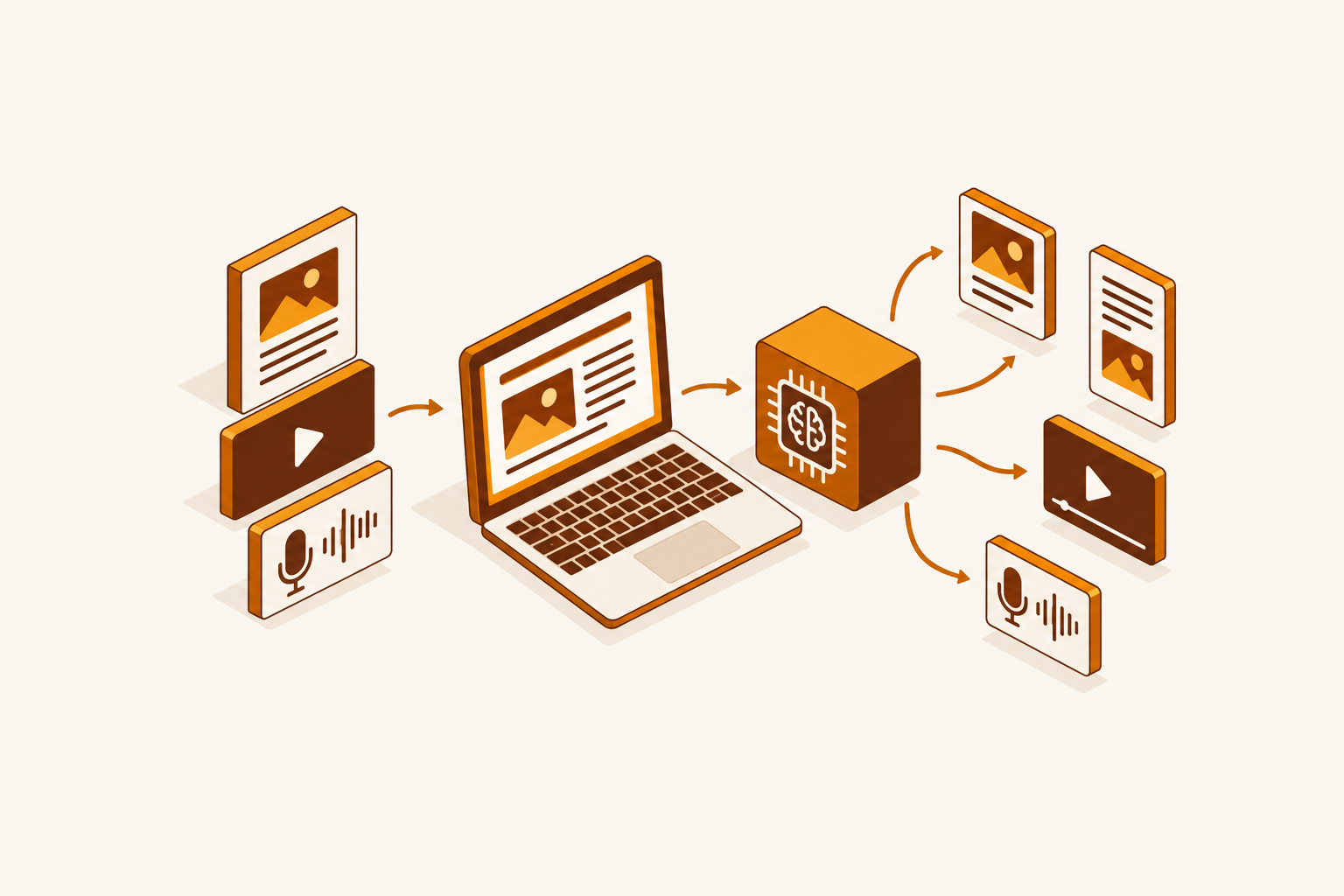
AI content repurposing preserves brand voice when structured, persistent brand context governs generation and review. Off-brand drift is visible in banned phrases, altered sentence rhythms, and generic openings in outputs, and in a rising ratio of edited-to-generated lines. To detect it, outputs must be checked against the current brand rules, with evidence for each pass or fail.
Why AI repurposing breaks voice at the structural level, not the prompt level
Teams expect repurposing to change the container while preserving the voice. Yet turning a blog post into a LinkedIn caption is not simply reformatting. The model extracts meaning and reconstructs it in the register its training associates with that platform. Without a stable model of the brand, platform conventions become the default constraint.
The first losses are often the least conspicuous. Sentence rhythm, preferred vocabulary, and the ways a brand signals authority or warmth get smoothed away because they are not the central information being extracted. A caption can therefore summarize its source accurately and still sound unlike the company that published it.
At volume, that distinction becomes an operational problem. As more outputs emerge from one source, hedges multiply, contractions disappear, and openings become generic. A brand that never uses “guys” or “in today's fast-paced world” can find both in the same batch. This failure spans general LLMs and repurposing-focused software because generation is widely available, while explicit voice modeling is not.
Why better prompts cannot close this gap on their own
A prompt describing a brand as “direct, warm, authoritative” leaves almost every important choice unresolved. Those adjectives fit thousands of brands with different vocabularies, sentence structures, and relationships to their audiences. The model still has to supply the missing detail from its own defaults.
Examples make that instruction substantially more useful. Previously published copy shows how directness or warmth appears in actual sentences, so careful prompts with examples improve consistency within a session. That is a real benefit, but a limited one. A prompt does not establish shared memory across sessions, agents, or team members, and its effect does not reliably survive a tool switch or model update.
The limitation becomes sharper when every repurposing job starts afresh. A team publishing across three or more channels weekly can produce drift faster than a prompt-review loop catches it. Each person must supply the right guidance, in the right form, for each job. Better prompting improves the local instruction, but it does not create a durable source of brand context.
What brand voice actually requires to survive format translation
A workable architecture has three layers, beginning with hard rules. These are versioned constraints on banned patterns and never-say phrases, maintained per content type. They need revisiting with every model release because a correction for one model can overcorrect another. Rules establish the boundaries that examples alone leave implicit.
The second layer is a voice specification with evidence. A one-page voice anchor names preferred and banned vocabulary, sentence length norms, permitted structures, and the brand’s perspective relative to its audience. Curated, previously shipped copy gives those choices substance, while examples the brand would never publish define the opposite boundary.
A channel modifier matrix then sits over that anchor. Formality, length, structure, and CTA style can change from one channel to another while personality markers stay the same. A LinkedIn caption can be shorter than its source without borrowing a different personality.
The third layer is a review gate with a named owner responsible for voice and facts. The ratio of edited-to-generated lines provides an actionable feedback signal, with a rising ratio indicating that rules or samples may have gone stale. To reduce handoff drift, the architecture can use a single tool with a brand voice profile or a centralized voice document supplied identically to every tool. Otherwise, each tool introduces another default personality for reviewers to correct.
Why machine-readable brand context is the structural answer to stateless tools
The artifact behind this architecture needs to serve agents directly. A 60-page brand book may explain identity well to people, but narrative paragraphs and visual layouts do not reliably expose enforceable constraints. An agent needs to distinguish a preference from a prohibition and a general rule from a channel-specific exception. A human-readable document alone leaves those distinctions open to interpretation.
Machine-readable brand context encodes that information in structured, validated files that agents can load, query, and apply. The content can include colors with usage rules, typography hierarchies, voice guidelines, and explicit constraints. The shift from PDF to text takes brand context from descriptions requiring interpretation to an artifact designed for operational use.
Created by Caio Pizzol, the permissively licensed open format expresses brand identity in a structured form that displays cleanly on GitHub and can be loaded by AI tools configured to receive it. brand.context addresses a different use case, namely purchase recommendations by AI agents. It translates eight evidence-grade decision-stage filter types from the AIVO Evidentia Filter Taxonomy into a structured JSON-LD schema published at a predictable domain location.
For AI search entity resolution, the signals are the same canonical description across surfaces, a clear category-plus-audience claim, and machine-readable identity links. These signals serve discovery rather than sentence-level voice control, but both depend on explicit identity. Documentation asks people to interpret and relay that identity, while infrastructure lets agents access it as a constraint.
How MCP makes shared brand context technically feasible across agents and products
Model Context Protocol, or MCP, supplies the connective layer between structured context and the agents that need it. The open standard is under the Agentic AI Foundation, which is a directed fund under the Linux Foundation. It lets agents connect securely to external tools, databases, and APIs through a single interface. Shared context no longer has to arrive through repeated copy-paste.
For brand retrieval, MCP servers for Notion and Google Drive let agents find voice profiles, ICP documents, and content calendars by name. Jasper extends this approach through its MCP server, which allows brand context to travel with users into other AI tools. Delivery becomes part of the workflow.
Access controls remain a separate concern from voice consistency. Frontify’s MCP server inherits existing user permissions and does not expand them, but the connection is not scoped to a particular brand or hub. An agent can see everything the user’s account can access across brands. That distinction is especially important where access spans multiple roles or regions.
In a multi-agent pipeline, shared access can connect calendars, keyword sets, brand rules, internal documents, and publishing tools within one workflow. MCP-compatible agents include Claude, ChatGPT, Claude Code, Cursor, and Codex, while a product can draw on the same versioned context through a REST API. The architectural goal is direct access to the source of truth. A connection supplies that access, while the context itself supplies the rules.
What current platforms do well and where the voice-fidelity gap persists
Jasper IQ embeds brand voice, style guides, audience profiles, and product knowledge into outputs across a team automatically. Jasper also has agents built for marketing, content pipelines that work across a team, and enterprise governance controls. Its Image Pipelines address on-brand product imagery at enterprise scale, while its MCP server extends brand context into other tools.
Writer is suited to teams needing approvals, audit trails, and model choice for agents across marketing and other departments. Bynder’s Brand Compliance Agents enforce logo placement, color palettes, messaging, and design templates at scale, with coherence checks against multiple rulesets for multi-brand and multi-market work.
Adobe Brand Visibility, announced June 2026, brings together Semrush’s AI visibility intelligence and Adobe’s agentic content optimization, with brand and business context as their shared base. That combination connects visibility intelligence with content optimization rather than treating voice as an isolated editing task. How a platform is judged thus depends on which part of the workflow needs control.
General LLMs offer medium tone fidelity and leave voice editing to users, while repurposing-focused software can still require guideline uploads for each project. Voice-modeling tools narrow that gap but can limit volume. More tools also mean more handoffs, so the decisive question is whether current brand context accompanies every output job or must be supplied again.
Why brand context needs versioning, not just documentation
A brand’s context changes when its visual identity, product range, or tone changes. If the guideline document is updated but agents retain earlier session context or project uploads, the update exists without reaching production. The system has two versions of the brand in circulation. Treating context like a software dependency means changing the source once and having connected work reflect the new version.
A voice rule tuned to one model may overcorrect after a model update, making the rule’s history essential to understanding a problematic batch. Without that history, teams cannot establish which constraint was active or return to a known-good state. The record needs to connect outputs with the context that governed them.
A practical test makes the distinction visible. If the approved color palette changes today, how many agents and products are still generating from yesterday’s palette by the end of the week? The answer reveals whether the change propagated or merely appeared in a document. The same test works when a tone guideline changes or a phrase is newly banned.
For agencies and multi-brand operators, this requires separate change histories for separate brands. An audit trail must identify both the brand and the version used for each output. Otherwise, an apparently compliant piece may have been checked against the wrong standard. The target is one current source for each brand, with changes reaching connected agents and products without manual re-uploading or re-pasting.
How to detect off-brand AI output before it ships
The ratio of edited-to-generated lines closes the loop between context and review. A rising edit ratio is the earliest operational signal that brand rules or examples may have become stale, before audience response exposes the problem. Review must show which constraints the output failed and whether the context needs to change.
The detection criteria should distinguish prohibited language from subtler voice changes. Banned phrases, generic openings, extra hedges, disappearing contractions, altered sentence rhythms, and vocabulary outside the voice anchor are concrete signals. Channel-specific checks then assess permitted formality, length, structure, and CTA style against the modifier matrix. This prevents an acceptable change in tone from being mistaken for a change in identity.
The practical audit assigns a pass or fail against each applicable rule and records the evidence for that judgment. It uses the current version of brand context. Automated compliance checks apply to every output, with named human review for high-stakes or public-facing pieces and subject-matter sign-off for regulated or sensitive content. The edit ratio then tracks how much correction this process requires.
Review also extends beyond written voice because repurposing produces images, video, and audio as well as copy. Logo placement and color palette compliance need checking with the same discipline as messaging. Google’s guidance says it is critical for people to fact-check AI-generated content and review it for accuracy and trustworthiness before publishing. Checking accuracy and checking the brand voice are separate duties, even when both happen at the same gate.
Connected agents generate from a structured, versioned source, and reviewers test their outputs against it with evidence. When the brand changes, both generation and review adopt the new standard. Voice fidelity then depends less on repeated instructions and more on a system that makes deviations visible before publication.