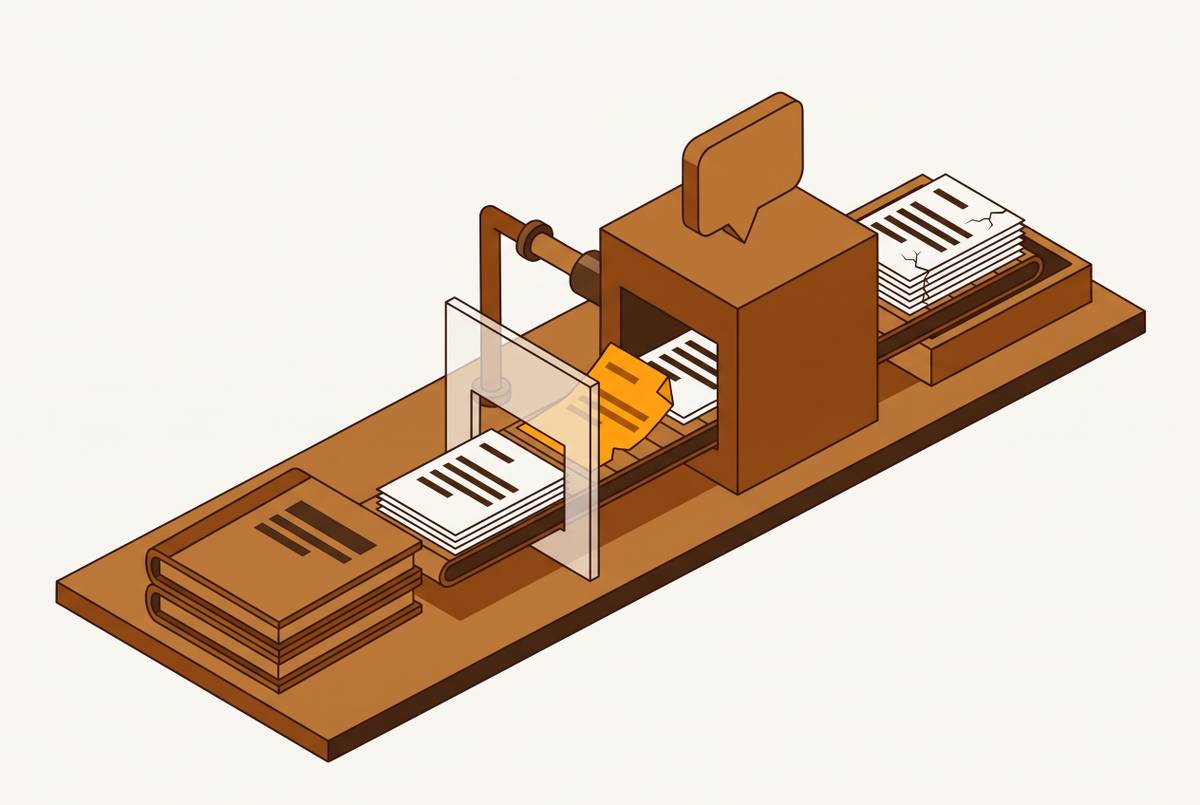
Few-Shot Example Selection for On-Brand LLM Output
Choosing the right examples teaches LLMs your brand's actual voice instead of generic copy.

Few-shot example selection for on-brand LLM output is a precision engineering decision. A brand’s proprietary voice is a domain pattern that a general-purpose model cannot be assumed to know. The model works within that pattern or falls back toward statistically average copy depending on the quality, diversity, and sequence of the examples supplied.
Why LLMs default to the statistical average and what that costs a brand
AI-generated copy can be fluent, coherent, and still generic. The sentences read well, yet their tone could belong to almost any company. General-purpose LLMs trained on web content gravitate toward the statistical average of that training distribution. The missing ingredient is context that demonstrates how this brand differs from the broader patterns the model already knows.
That distinction becomes more consequential as content production expands across agents, formats, and touchpoints. Each piece that drifts slightly from the intended voice contributes to a less coherent aggregate identity. A support email and a social post can sound different while reflecting the brand’s conventions. This makes brand voice a domain-specific prompting problem. The model needs demonstrations of the pattern it is expected to follow.
What few-shot examples actually do inside the model
Few-shot examples do not primarily teach entirely new input-output mappings. Their practical role is to activate the model’s latent understanding of a format and register. Examples indicate how long an answer should be, which vocabulary fits, and what structural conventions govern the result. They establish the conditions under which writing should happen. For brand work, those conditions include the tonal, lexical, and structural choices that distinguish the company’s voice.
An example shows several linked choices at once, including sentence length, how formal the writing is, and how the message is put together. An abstract instruction says what is wanted, while an example shows how that choice works in practice. The distinction changes what example selection must accomplish. Its purpose is not to collect appealing copy but to specify the register appropriate to the requested output.
Poorly chosen examples anchor the model to the wrong conventions. More emphatic system-prompt instructions do not resolve that conflict reliably, because the demonstrations continue to show a different target. Selection quality is thus part of the task specification.
The failure modes that follow from treating example selection as an afterthought
Majority label bias appears when one category dominates the examples and the model over-predicts it. In brand work, an over-represented tone or format can become the default even when the request calls for something different. A brand with distinct LinkedIn and email voices then gets one averaged voice. The imbalance is easy to overlook during selection. Each sample can be individually good while the set remains poorly suited to the range of tasks.
Few-shot collapse creates a different risk. Adding examples beyond an optimal count does not steadily improve performance and can sharply degrade it. More demonstrations are not automatically more useful context. For brand teams, this means that enlarging a prompt cannot substitute for choosing examples that fit the task.
Incidental conventions can also propagate without being intended as rules. A static set of three examples that all use a formal register, long sentences, and Oxford commas quietly establishes that combination as the expected pattern. Social posts, support emails, and product pages are then pushed toward the same mold. These failures can coexist, making it difficult to distinguish deliberate brand consistency from repetition caused by the example set.
Why static example sets cannot serve a brand's full range of formats and tones
Static few-shot prompting uses the same set of examples for every request. That approach can work well when the task is narrow and homogeneous. Brand content operations rarely meet that condition. A LinkedIn thought-leadership post, a transactional support email, and a homepage headline each need a different register within the same brand voice. A small fixed set cannot show all of those uses equally well.
When examples favor one format, its conventions can spread into the others. The copy may be in the requested format yet sound wrong for its audience or channel. The prompt is asking a fixed set of demonstrations to represent a changing set of tasks, so the brand’s range is reduced to whatever the examples happen to cover.
Maintenance adds another source of conflict. After a repositioning or a change in tone, a team may update the instruction but leave old examples in each prompt. The instruction now describes the intended voice, but the demonstrations still teach the previous one. Static selection remains appropriate where a narrow task is measured to benefit from it. For teams handling a wider range of brand work, the source of examples needs to adapt as tasks and the brand change.
How dynamic example selection works and what it requires to work well for brand voice
Dynamic selection retrieves relevant examples for each incoming request from a curated pool. Each example is embedded as a dense vector, a numerical representation of its semantic content. The new request is represented in the same way, and cosine similarity identifies candidates whose representations are closest to it. The model receives the selected examples. Retrieval therefore changes which demonstrations reach the model, but cannot compensate for missing or unsuitable material in the pool.
For brand teams, the practical requirement is a curated library of approved outputs tagged by format, audience, channel, and product line. It is not an archive of everything published. Examples should reflect real inputs and cover the cases the model will face, including edge cases. Real production samples provide demonstrations of the brand operating under actual content demands, while synthetic or simplified examples can underperform, depending on the context.
A pool containing many topics in one format still offers only a narrow range of structural and tonal conventions. Relevant content is not necessarily a relevant demonstration. The pool needs format variation so that retrieval can supply examples suited to the requested register.
Three to five examples retrieved from that pool is a starting range to work with. The aim is to give enough context to show the pattern and useful exceptions without prompting too much pattern-matching. That range is a working heuristic to assess against performance on the actual task.
Sequencing and ordering as the overlooked dimension of example engineering
The order of examples is a separate engineering variable. Swapping example order has shifted accuracy by more than 10 percentage points on some classification benchmarks. That finding shows that arrangement matters, with an equivalent gain for brand copy still unestablished.
Intuit AI Research’s Learning to Search Effective Example Sequences for In-Context Learning uses Beam Search-based Example Sequence Constructor, or BESC, to work on how long the sequence is, which examples it contains, and what order they appear in, all together. The research treats these factors as interdependent. That framing is useful for brand workflows because changing the count also changes the balance of conventions, while changing the order changes which example appears last. Selecting strong samples in isolation leaves those relationships unresolved.
General brand voice examples can appear early to establish the baseline, followed by format-specific examples and then the closest semantic match to the task. Because recency bias gives the final example disproportionate influence, that last example should also closely match the target tone and format. Progressive complexity can introduce exceptions after the baseline is clear. The ordering rule should be documented so sequencing remains repeatable across people assembling prompts.
Why brand voice examples must be verified outputs, not brand guideline prose
Brand guidelines describe voice for humans to interpret. They are not themselves few-shot demonstrations of that voice. A rule describing a brand as warm, direct, and never corporate leaves the person drafting a support email to decide what those qualities mean. An approved support email shows how those choices have been made. It demonstrates how warmth and directness coexist within the length, vocabulary, and structure of that format.
This distinction sets the sourcing standard for the pool. Every example should be content that has been approved, published, or explicitly designated as canonical, rather than a hypothetical illustration lifted from a guideline. The model needs a demonstrated instance of the rule. Guideline prose can state the requirement, but it does not replace evidence of the requirement applied to an actual output.
If a channel or format calls for a departure from the baseline voice, the pool should contain an approved example of that departure. Merely stating that exceptions exist leaves their execution unspecified. As new content receives brand approval, strong outputs become candidates for the library.
Treating brand examples as versioned infrastructure rather than static prompt fixtures
A pool built once preserves a snapshot of the brand. It needs updates to keep pace as products, audiences, and tone change. Dynamic retrieval selects from the available material, making retrieval quality distinct from the maintenance quality that keeps examples current. A well-matched example can still be wrong for the brand’s present direction.
The instruction-example mismatch is especially difficult to detect because it does not necessarily produce visibly broken output. Copy can still read well and sound credible while leaning toward an older voice. For that reason, brand examples should be versioned with the same discipline as code. Changes should be tracked, previous versions retained for rollback, and new examples reviewed before entering the pool. Every agent drawing on the store should have access to its current state.
Social copy, email, web pages, and presentation decks can use different examples from the same canonical pool without each needing its own definition of the brand. Local example lists create separate update obligations and opportunities for drift. The infrastructure goal is one current source of truth whose changes propagate to connected agents and products. Versioning makes that shared context manageable without sacrificing the ability to recover an earlier state.
Closing the loop: reviewing AI output against the brand as a signal for example improvement
Versioning tracks changes, but review shows which changes are needed. A systematic review process identifies which outputs align with the brand, which drift, and where the drift occurs. Without it, teams lack a reliable signal that an example set is missing a format or encouraging the wrong register. Approval alone provides too little diagnostic information. Useful review evidence connects an output’s strengths or failures to specific brand requirements.
Brand review checks finished work against the logo, type, color, imagery, and voice rules that define the brand. For example improvement, the voice-specific evidence identifies the dimension that drifted and the format in which it happened. Outputs with strong evidence of alignment become candidates for the pool. Failed outputs indicate where coverage of a format or edge case may need to improve. Review thus serves both as an output quality gate and as an input to future selection.
This creates a continuing cycle in which generation draws on approved examples, review evaluates the result, and the evidence informs additions to the library. Improvement can follow content production between periodic audits. Human judgment still establishes what belongs in the brand’s canonical set, but that judgment becomes reusable across connected workflows. Brand voice remains a proprietary domain pattern requiring precise demonstrations. The feedback loop makes that precision maintainable as the brand and its content demands evolve.
Sources
GuideBrand Voice Examples: Six Voices Written So People and AI Can Use Them